
AI EHR Integration: Connecting AI to Health Records
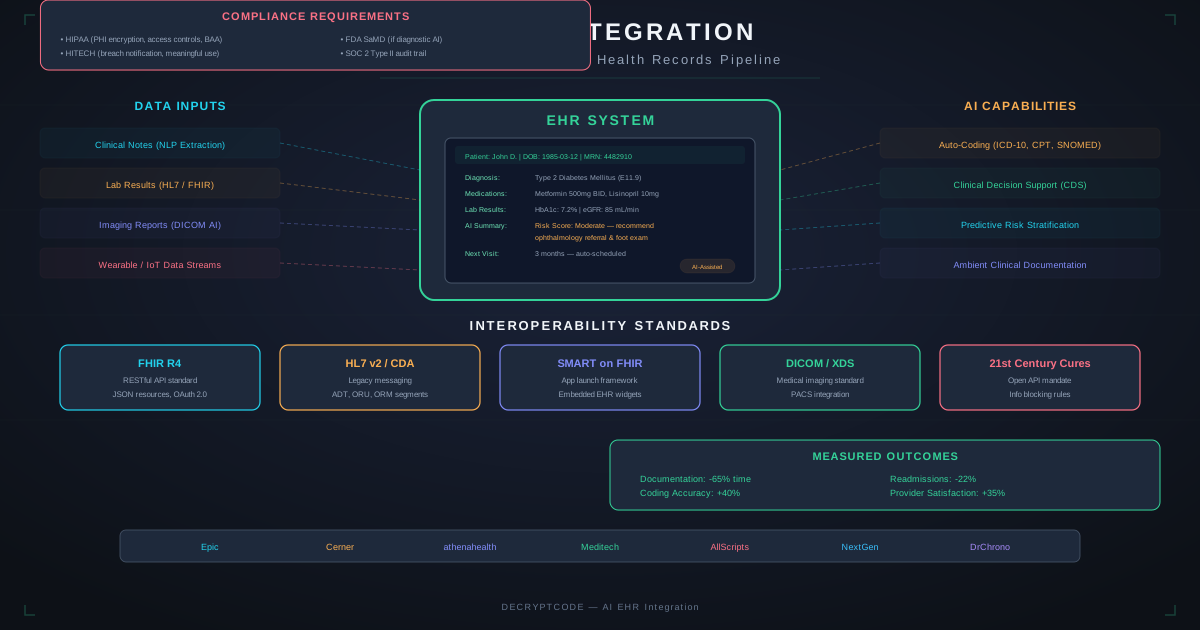
Integrating AI with Electronic Health Records requires navigating FHIR standards, EHR vendor APIs, clinical NLP pipelines, and HIPAA compliance. This guide covers the technical architecture, integration patterns, and real-world lessons from production EHR-AI deployments.
Key Takeaways
- FHIR R4 is the standard for EHR integration — mandated by ONC for certified EHRs in the US
- Clinical NLP extracts structured data from unstructured notes: diagnoses, meds, labs, procedures
- Epic, Cerner, and Athenahealth all provide FHIR APIs — but each has vendor-specific quirks
- AI writes back to EHR via CDS Hooks (real-time alerts) or SMART on FHIR apps (embedded UI)
- Biggest challenge isn't technology — it's EHR vendor approval timelines (3-12 months)
EHR Integration Landscape
The healthcare interoperability landscape has improved dramatically since the 21st Century Cures Act mandated standardized APIs. Today's integration options:
- FHIR R4 APIs: Modern RESTful APIs with standardized resources. All certified EHRs must support FHIR R4. The primary path for new AI integrations.
- HL7 v2 Messages: Legacy message format still widely used for ADT (admit/discharge/transfer), lab results, and orders. Interface engines (Mirth Connect, Rhapsody) translate HL7v2 to AI-friendly formats.
- CDA/C-CDA Documents: XML-based clinical documents for care transitions. Useful for bulk data extraction but less suitable for real-time AI workflows.
- Vendor-Specific APIs: Epic's Open.Epic, Cerner's Millennium, proprietary extensions beyond FHIR. Sometimes necessary for data not yet available via FHIR.
- Database Direct: Reporting databases (Epic Caboodle/Clarity, Cerner HealtheDataLab). Best for batch AI training data extraction, not real-time integration.
FHIR for AI
FHIR (Fast Healthcare Interoperability Resources) provides the data foundation for healthcare AI:
Key FHIR Resources for AI
| Resource | Contains | AI Use Case |
|---|---|---|
| Patient | Demographics, identifiers | Patient matching, cohort selection |
| Condition | Diagnoses (ICD-10) | Risk prediction, comorbidity analysis |
| MedicationRequest | Prescriptions | Drug interaction, adherence prediction |
| Observation | Lab results, vitals | Anomaly detection, trend analysis |
| DocumentReference | Clinical notes, reports | NLP extraction, summarization |
| Encounter | Visits, admissions | Utilization prediction, readmission risk |
| DiagnosticReport | Imaging/lab reports | AI-assisted interpretation |
FHIR Bulk Data Access
For AI training and batch processing, FHIR Bulk Data Access ($export operation) exports entire patient populations as NDJSON files. This is the efficient path for building training datasets, populating RAG knowledge bases, and running batch predictions.
CDS Hooks
Clinical Decision Support Hooks let AI inject real-time recommendations into EHR workflows:
- patient-view: When a clinician opens a patient chart → AI surfaces risk scores, care gaps
- order-select: When an order is placed → AI checks for drug interactions, guideline compliance
- encounter-discharge: At discharge → AI recommends follow-up actions, identifies readmission risk
EHR Vendor APIs
Epic Integration
- Open.Epic: FHIR R4 APIs for patient data, clinical documents, scheduling
- App Orchard → Cosmos: Epic's marketplace for third-party apps. Approval process: 3-6 months.
- SMART on FHIR: Embedded apps launched within the Epic UI. Best for clinician-facing AI tools.
- Epic Interconnect: Web services for real-time data exchange
Cerner/Oracle Health Integration
- Millennium FHIR APIs: FHIR R4 for clinical data access
- Code Console: Developer portal for API access and app registration
- PowerChart Extensions: Custom components embedded in clinician workflows
Athenahealth Integration
- API Marketplace: REST APIs for clinical, financial, and administrative data
- FHIR APIs: Standards-based access to patient and clinical data
Clinical NLP Pipeline
80% of clinical data is in unstructured text (progress notes, discharge summaries, radiology reports). Clinical NLP extracts structure:
- Section Detection: Identify note sections (History of Present Illness, Assessment, Plan, Medications)
- Medical NER: Extract entities — diagnoses (ICD-10 mapping), medications (RxNorm), procedures (CPT), labs (LOINC), anatomy (SNOMED CT)
- Negation Detection: Critical in clinical text. "Patient denies chest pain" — chest pain is mentioned but negated. NegEx or transformer-based negation models.
- Temporal Reasoning: When did events occur? "Started metformin 3 months ago" vs. "Will start metformin tomorrow"
- Relation Extraction: Link entities — which medication treats which condition, which lab is abnormal for which diagnosis
- Normalization: Map free-text mentions to standard codes (ICD-10, RxNorm, SNOMED)
Modern approach: Fine-tuned clinical LLMs (or prompted general LLMs like Claude/GPT-4) can often handle steps 1-5 in a single pass, replacing the traditional multi-step NLP pipeline. See our document ingestion pipeline guide for the technical architecture.
Integration Architecture
Production AI-EHR integration architecture:
- Integration Engine: Mirth Connect or Rhapsody handles HL7v2/FHIR translation, message routing, and protocol conversion
- FHIR Server: HAPI FHIR or Microsoft FHIR Server as a normalized data layer between EHR and AI
- AI Processing: LLM/ML models for clinical NLP, risk prediction, and decision support
- CDS Service: CDS Hooks endpoint that EHR calls for real-time decision support cards
- SMART App: React-based UI embedded in EHR for complex AI interactions (summaries, chat, visualizations)
- Audit Layer: HIPAA-compliant logging of all data access and AI decisions
See our EHR AI case study for a production implementation that achieved 82% faster clinical data processing.
AI-EHR Use Cases
- Clinical Documentation: AI generates draft notes from visit recordings, extracts billing codes, and identifies documentation gaps
- Prior Authorization: AI reads authorization requirements, maps to patient data in EHR, auto-generates submission with supporting clinical evidence
- Readmission Prediction: Real-time risk scores at discharge based on clinical data, social determinants, and historical patterns
- Medication Reconciliation: AI compares medication lists across care settings, identifies discrepancies, suggests resolutions
- Patient Intake Automation: AI processes intake forms, insurance cards, and referral documents into structured EHR fields
- Care Gap Detection: AI scans patient records against quality measures (HEDIS, MIPS) to identify overdue screenings and preventive care
Common Challenges
- Vendor approval timelines: Getting your AI app approved in Epic's App Orchard or Cerner's marketplace takes 3-12 months. Start early.
- Data quality: Clinical data is messy — free text, abbreviations, typos, inconsistent coding. Plan for robust data cleaning.
- Workflow disruption: Clinicians are already overwhelmed. AI tools must save time, not add clicks. Embed in existing workflows, don't create new ones.
- Clinical validation: AI recommendations need clinical validation before deployment. Engage physician champions early.
- Multiple EHR instances: Health systems often run multiple EHR versions. Plan for variation in FHIR support and data availability.
Implementation Guide
- Weeks 1-2: FHIR API access provisioned, sandbox environment setup, data mapping analysis
- Weeks 3-6: Clinical NLP pipeline development and validation against gold-standard annotations
- Weeks 7-10: AI model integration, CDS Hooks or SMART app development, HIPAA compliance verification
- Weeks 11-14: Clinical pilot with physician champions, accuracy validation, workflow refinement
- Weeks 15-18: EHR marketplace submission, security review, production deployment
Need help with EHR integration? See our healthcare AI development services.
Frequently Asked Questions
What is FHIR and why does it matter for AI?
FHIR is the modern standard for healthcare data exchange with RESTful APIs. It provides standardized, programmatic access to EHR data, enabling AI systems to read and write clinical information without custom integrations per vendor.
How do I extract structured data from clinical notes?
Use clinical NLP: medical NER models extract diagnoses, medications, procedures, and lab values. Negation detection identifies ruled-out conditions. Fine-tuned clinical LLMs can handle the full pipeline in a single pass with 85-95% accuracy.
Which EHR systems support AI integration?
Epic (Open.Epic, App Orchard), Cerner/Oracle Health (Millennium APIs, Code Console), and Athenahealth (API Marketplace) all support FHIR R4-based integration mandated by the ONC Cures Act.
Connect AI to Your Health Records
FHIR integration, clinical NLP, and compliant AI pipelines — from Epic to production.
Start a Project