
AI Engineering
Enterprise RAG Pipeline Development
We build production-grade Retrieval-Augmented Generation systems that ground LLM responses in your proprietary data. Vector databases, hybrid search, semantic chunking, re-ranking, and citation-grounded answers — engineered for accuracy, scale, and compliance.
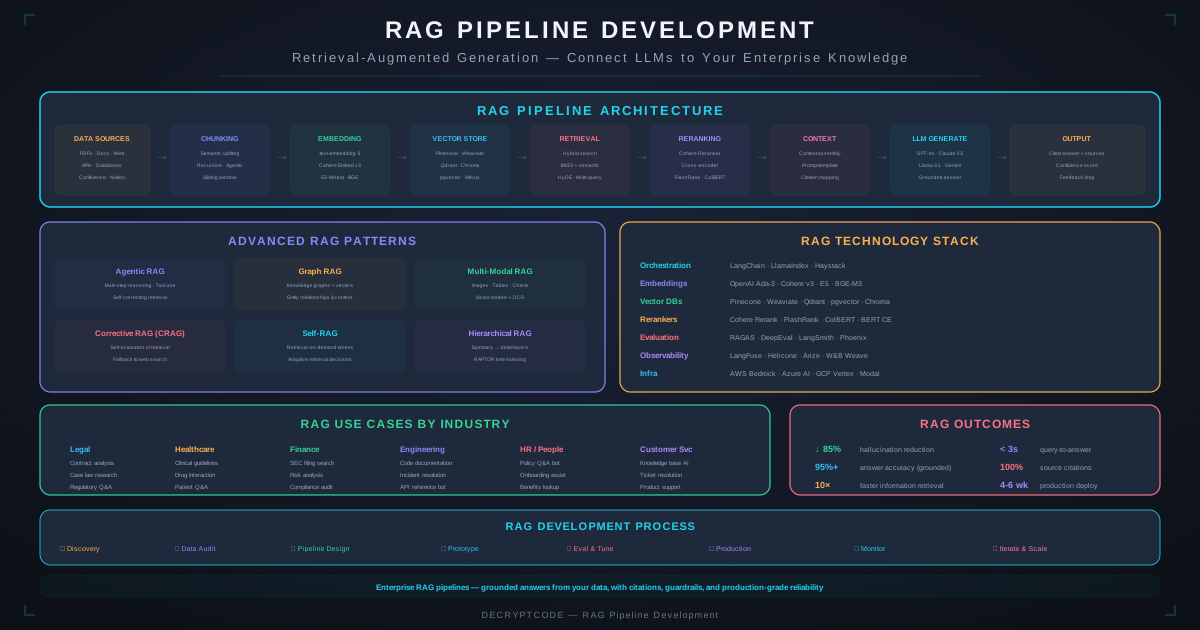
What Is RAG?
Retrieval-Augmented Generation (RAG) is an AI architecture that enhances LLM responses by retrieving relevant information from your proprietary data sources before generating answers. Instead of relying solely on the model's training data — which may be outdated or lack your domain knowledge — a RAG pipeline searches your documents, databases, and knowledge bases to provide accurate, citation-backed responses grounded in your actual business data.
RAG solves the two biggest problems with LLMs in enterprise: hallucination (making up facts) and data freshness (knowledge cutoff dates). With RAG, every AI response can be traced back to a specific source document, giving your teams confidence to rely on AI-generated insights for critical business decisions.
Why RAG for Enterprise?
- Accuracy with citations — every answer references specific source documents
- No model retraining — add new data instantly without fine-tuning
- Data privacy — your proprietary data stays in your infrastructure
- Cost efficiency — cheaper than fine-tuning for most use cases
- Auditability — full chain of evidence from query to answer
What We Build
RAG Pipeline Capabilities
Document Ingestion
Automated pipelines that ingest PDFs, Word docs, web pages, Confluence, SharePoint, Slack, and databases. Semantic chunking with metadata preservation.
Hybrid Search
Dense vector search (semantic) combined with sparse retrieval (BM25/keyword) using reciprocal rank fusion for maximum recall and precision.
Re-Ranking & Filtering
Cross-encoder re-rankers and metadata filters that ensure only the most relevant chunks reach the LLM — reducing cost and improving answer quality.
Citation Grounding
Every AI response includes inline citations linking to source documents. Users can verify claims, building trust and enabling compliance audits.
Evaluation & Testing
Automated evaluation harnesses measuring retrieval quality (MRR, NDCG), answer faithfulness, and relevance. Continuous regression testing.
Multi-Modal RAG
RAG systems that work with text, tables, images, and charts. Extract knowledge from complex documents that contain mixed content types.
Technology
RAG Tech Stack
FAQ
RAG Pipeline Development Questions
What is RAG (Retrieval-Augmented Generation)?
RAG is an AI architecture that enhances LLM responses by retrieving relevant information from your proprietary data before generating answers. Instead of relying solely on the model's training data, RAG systems search your documents, databases, and knowledge bases to provide accurate, up-to-date, citation-backed responses grounded in your actual business data.
How much does enterprise RAG implementation cost?
Enterprise RAG implementation typically costs $50,000-$200,000+ depending on data volume, number of data sources, accuracy requirements, and compliance needs. A basic RAG prototype can be delivered in 4-6 weeks for $30,000-$50,000. Production systems with hybrid search, re-ranking, and evaluation frameworks are at the higher end.
What is the difference between RAG and fine-tuning?
RAG retrieves relevant context at query time from external data sources, while fine-tuning modifies the LLM's weights with your domain data. RAG is better for frequently changing data, factual accuracy with citations, and when you need to audit sources. Fine-tuning is better for style/tone adaptation and specialized reasoning. Many production systems use both. Read our detailed comparison.
Which vector database should I use for RAG?
The best vector database depends on your requirements. Pinecone offers managed simplicity and scale. Weaviate provides hybrid search out-of-the-box. pgvector is ideal if you're already on PostgreSQL. Qdrant offers excellent filtering performance. We evaluate your data patterns, query needs, and infrastructure preferences to recommend the best fit.
Ready to Build Your RAG Pipeline?
Tell us about your data and use case — we'll design a RAG architecture and provide a detailed estimate within 48 hours.
Get Free Consultation