
AI Engineering
Enterprise AI Agent Development
We build autonomous AI agents that reason, plan, and execute complex business tasks — with tool use, persistent memory, guardrails, and human-in-the-loop controls. From single-agent automations to multi-agent orchestration systems that transform enterprise operations.
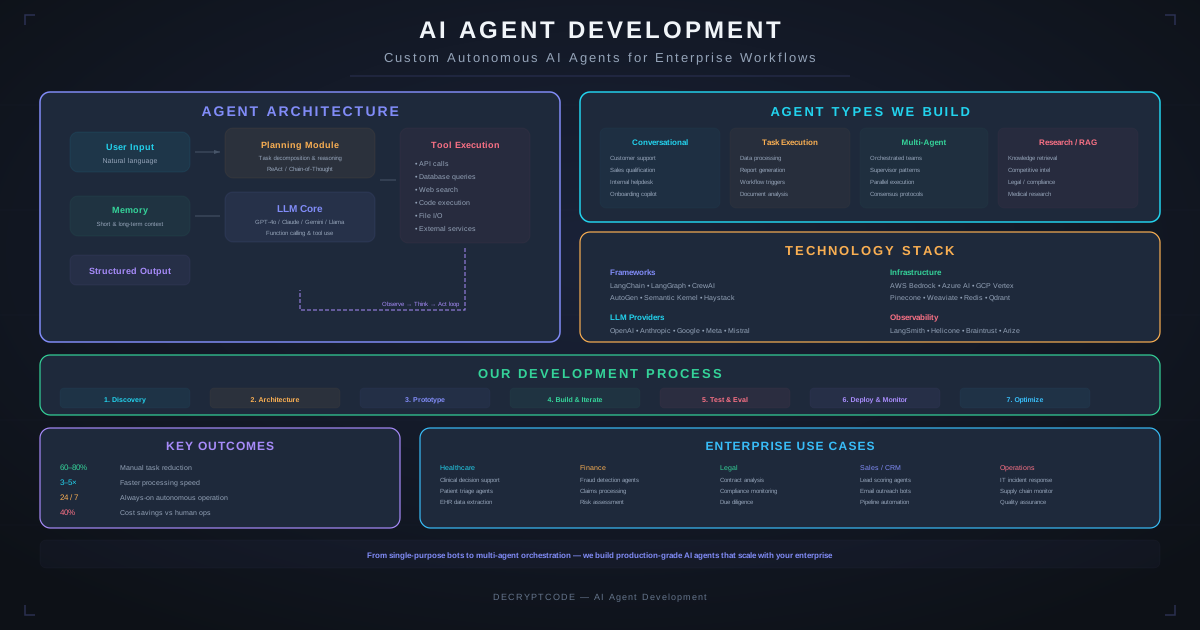
What Is an AI Agent?
An AI agent is an autonomous software system powered by large language models (LLMs) that can perceive its environment, reason about tasks, make decisions, and take actions to achieve specific goals. Unlike traditional chatbots that simply respond to prompts, AI agents can:
- Use tools — call APIs, query databases, search the web, execute code
- Maintain memory — remember context across sessions and interactions
- Plan multi-step workflows — break complex tasks into sub-tasks and execute them sequentially or in parallel
- Collaborate — work with other AI agents in coordinated multi-agent systems
- Self-correct — evaluate their own outputs and retry with different approaches
DecryptCode builds production-grade AI agents for enterprise — not demos. Our agents handle real workloads in healthcare, fintech, insurance, and SaaS environments with the reliability, security, and observability that enterprise demands.
What We Build
AI Agent Capabilities
Single-Agent Automation
Autonomous agents that handle complete business processes end-to-end — data entry, document review, customer responses, report generation — with human oversight for edge cases.
Multi-Agent Orchestration
Coordinated agent teams where specialized agents collaborate on complex tasks. Supervisor agents manage workflow, delegate tasks, and ensure quality across the agent pipeline.
Tool-Use & API Integration
Agents that interact with your existing systems — CRM, EHR, databases, APIs, cloud services. We build robust tool definitions with error handling and retry logic.
Memory & Context Management
Short-term and long-term memory systems that let agents maintain context across sessions, remember user preferences, and build knowledge over time.
Guardrails & Safety
Enterprise-grade guardrails — input validation, output filtering, content safety, PII detection, action constraints, and approval workflows for high-risk operations.
Agent Observability
Full observability into agent reasoning — decision logs, action traces, performance metrics, cost tracking, and anomaly detection for production monitoring.
Technology
AI Agent Tech Stack
Our Process
How We Build AI Agents
Discovery & Use Case Mapping
We identify the highest-impact workflows for agent automation. Map decision trees, data sources, integration points, and define success metrics.
Week 1-2Agent Architecture Design
Design agent roles, tool definitions, memory systems, guardrails, and orchestration patterns. Choose frameworks and LLMs based on requirements.
Week 2-3Build & Iterate
Rapid prototyping with real data. Iterative development in 2-week sprints. Continuous testing against edge cases and failure scenarios.
Week 3-10Production Deployment
Enterprise deployment with monitoring, alerting, cost tracking, and graceful degradation. Human-in-the-loop workflows for critical decisions.
Week 10-12Proof of Work
AI Agent Case Studies
Multi-Agent CRM Pipeline
LangGraph multi-agent system automating lead scoring, outreach, and pipeline management for 50K+ accounts.
AI EHR Onboarding Automation
AI-powered document extraction pipeline reducing patient onboarding from 45 minutes to 8 minutes.
FAQ
AI Agent Development Questions
What is an AI agent and how does it work?
An AI agent is an autonomous software system that can perceive its environment, reason about tasks, make decisions, and take actions to achieve specific goals. Unlike simple chatbots, AI agents can use tools (APIs, databases, web search), maintain memory across interactions, plan multi-step workflows, and collaborate with other agents. They combine large language models with orchestration frameworks like LangChain and CrewAI.
How much does enterprise AI agent development cost?
Enterprise AI agent development typically costs between $75,000 and $300,000+ depending on complexity, number of agents, integrations needed, and compliance requirements. A single-agent proof of concept can start at $30,000-$50,000. Multi-agent systems with enterprise integrations and guardrails are at the higher end. Contact us for a detailed estimate.
What is the difference between AI agents and chatbots?
Chatbots respond to user messages in a conversational interface. AI agents go further — they can autonomously plan and execute multi-step tasks, use external tools and APIs, maintain persistent memory, collaborate with other agents, and make decisions with minimal human oversight. AI agents are proactive, while chatbots are reactive.
What frameworks do you use to build AI agents?
We build AI agents using LangChain, LangGraph, CrewAI, AutoGen, and custom orchestration frameworks. The choice depends on your requirements: LangGraph for complex stateful workflows, CrewAI for role-based multi-agent collaboration, and custom architectures when off-the-shelf frameworks don't meet performance or compliance needs.
Ready to Build Your AI Agent?
Tell us about your use case — we'll design an agent architecture and provide a detailed estimate within 48 hours.
Get Free Consultation