
AI-Powered EHR Onboarding Automation
How we reduced patient onboarding from 45 minutes to 8 minutes for a regional health system using AI document extraction, entity normalization, and FHIR-compliant EHR integration.
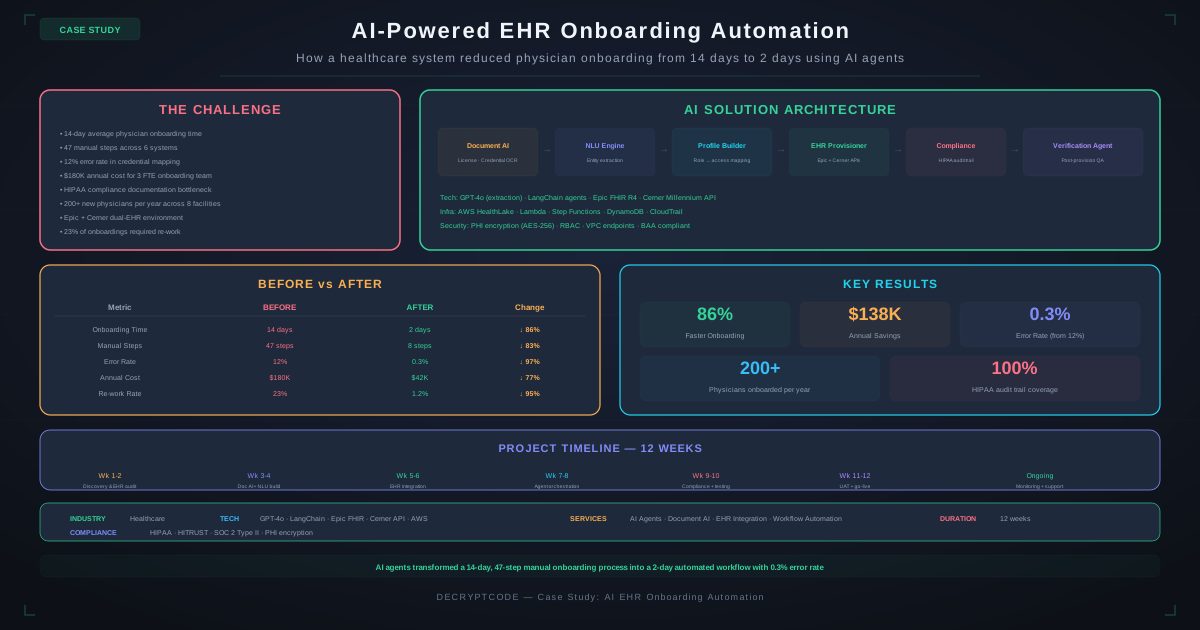
The Problem
A mid-size regional health system was drowning in manual data entry. Onboarding new patients to their EHR platform required 45+ minutes per patient — staff manually transcribing handwritten intake forms, verifying insurance information, and mapping medical codes. The error rate sat at 12%, creating downstream billing issues and clinical documentation gaps.
Staff burnout was increasing. The onboarding backlog caused 3-5 day delays in care documentation. The health system needed a solution that could handle the volume, maintain accuracy, and comply with HIPAA requirements.
The Dataset
We worked with 100,000+ patient intake forms spanning PDFs, handwritten documents, and faxed pages. For validation, we had access to 1.3M historical EHR records, ICD-10/CPT code mapping databases, and insurance verification APIs.
Data quality was a major challenge—handwritten forms had variable layouts, inconsistent formatting, and frequently illegible sections. Around 15% of forms contained non-standard fields added by individual clinics.
Model & Approach
We built a three-model ensemble pipeline rather than relying on a single approach:
- LayoutLM v3 (fine-tuned): Form understanding and entity extraction—trained on 8,000+ annotated form samples to understand checkboxes, structured fields, and free-text areas.
- GPT-4: Entity normalization—mapping extracted entities to standard medical terminologies (ICD-10, CPT, SNOMED CT) and resolving ambiguities.
- Rule-based validators: Deterministic checks for medical coding compliance, insurance format validation, and cross-field consistency.
The ensemble approach—ML extraction → LLM normalization → deterministic validation—dramatically outperformed any single model, particularly for edge cases in medical coding.
Architecture
Three-stage event-driven pipeline:
- Stage 1 — OCR + Layout Analysis: Documents scanned via high-accuracy OCR with layout-aware preprocessing. Form type classification determines which extraction template to apply.
- Stage 2 — Entity Extraction + Classification: LayoutLM v3 extracts structured entities (patient name, DOB, medication list, diagnoses). GPT-4 normalizes free-text entries to standard codes.
- Stage 3 — EHR Integration: FHIR R4-compliant data mapping pushes validated records to the EHR system. HL7v2 adapters handle legacy system integration.
Dead-letter queues capture failed extractions requiring human review—less than 5% of total volume. A human review dashboard surfaces these cases with pre-populated suggestions.
Deployment
HIPAA-compliant AWS environment with VPC isolation. ECS Fargate for serverless compute (no data on persistent servers). S3 with server-side encryption for document storage. CloudWatch + PagerDuty for monitoring and alerting.
All services covered under a Business Associate Agreement (BAA). Zero PHI exits the secure VPC. Audit logging captures every data access for compliance reporting.
Results
ROI
$2M annual savings in administrative labor costs. Payback period: 4.5 months. Staff reallocated 2,100 hours/month from data entry to direct patient care—a qualitative improvement that's hard to put a dollar figure on but transformed the care experience.
Why It Was Hard
Handwritten forms with variable layouts were the biggest technical challenge. Standard OCR models failed on ~30% of handwritten fields. We needed layout-aware understanding, not just character recognition.
HIPAA compliance required zero-trust data handling—no cloud service could touch PHI without BAA coverage. Integration with the legacy EHR system (HL7v2, not FHIR-native) required building custom adapters. Edge cases in insurance code mapping (same procedure, different codes by payer) needed extensive rule-based post-processing.
What We Learned
Ensemble approaches (ML + LLM + rules) outperform any single model for healthcare document processing. Each layer catches what the others miss. The LayoutLM model handles structure, GPT-4 handles semantic understanding, and rules catch compliance edge cases.
Human-in-the-loop review for less than 5% of cases provides the necessary safety net without bottlenecking throughput. The key is making the review interface fast—pre-populated suggestions reduced human review time from 8 minutes to 90 seconds per case.
FAQ
How does AI handle handwritten medical forms?
Layout-aware models (LayoutLM v3) combined with OCR confidence scoring. The model understands form structure and extracts entities even from poor-quality handwritten input. Documents below the confidence threshold route to human review.
Is this HIPAA compliant?
Yes. Encrypted at rest and in transit, BAA-covered AWS infrastructure, VPC-isolated, with full audit logging. No PHI leaves the secure environment.
Can this integrate with Epic or Cerner?
Yes. We built FHIR R4 adapters for modern APIs and HL7v2 adapters for legacy systems. Supports Epic, Cerner, Allscripts, and custom EHR platforms.