
Reasoning Models in 2026: o3, o4-mini, and Claude's Extended Thinking
Reasoning models don't just predict the next token — they think before they answer. This guide explains the architecture, benchmarks, cost implications, and when reasoning models actually outperform standard LLMs in enterprise applications.
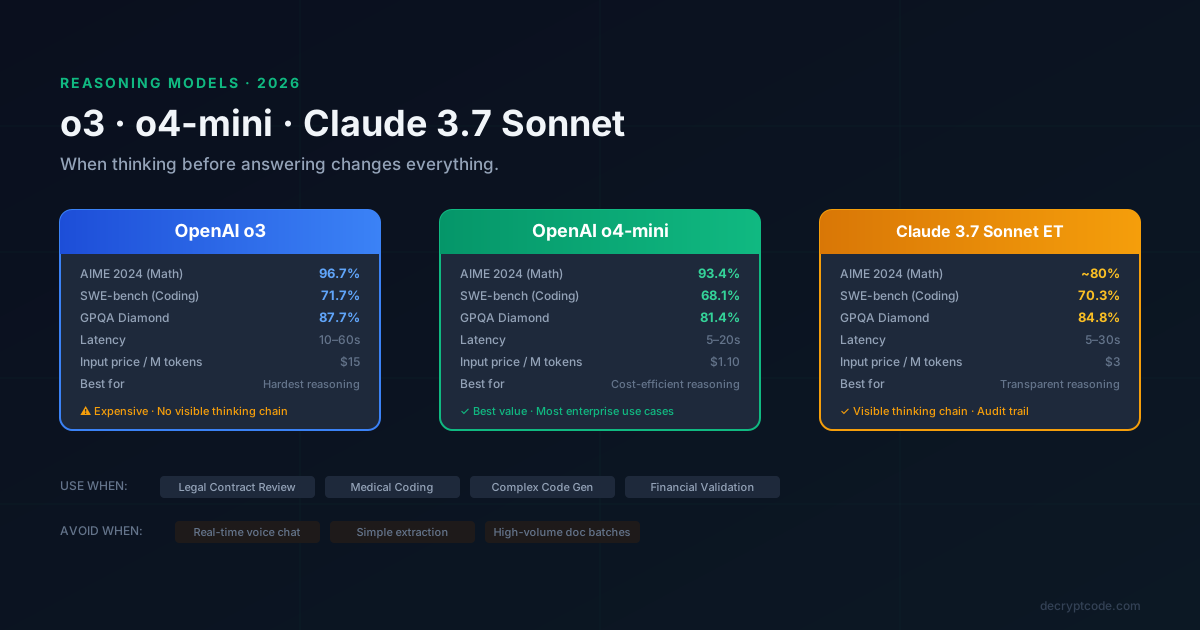
Table of Contents
What Are Reasoning Models?
Reasoning models are large language models trained — typically via reinforcement learning on outcome-based rewards — to spend tokens on internal deliberation before generating a response. Rather than immediately predicting the most likely next token given the prompt, they first produce an internal "thinking" trace that explores the problem space, tests hypotheses, and self-corrects before committing to an answer.
OpenAI's "o" series (o1, o3, o4-mini) and Anthropic's Extended Thinking mode in Claude 3.7 Sonnet are the leading examples as of mid-2026. Google DeepMind's Gemini 2.0 Flash Thinking and Meta's reasoning variants also exist, with varying levels of production readiness.
How They Work: Chain-of-Thought at Inference
Standard LLMs are trained to predict the next token. Reasoning models are trained with an additional phase — typically RL with a verifiable reward signal — where the model learns that generating internal deliberation steps leads to better final answers on hard problems.
The Thinking Block
When you call Claude 3.7 Sonnet with Extended Thinking enabled, the API response contains two parts: a thinking block (the internal reasoning, visible to you) and an assistant block (the final answer). You can inspect the thinking for debugging — it's often revealing. A model that reasons correctly about the wrong problem shows a different failure signature than one that makes an arithmetic error mid-reasoning.
Budget Tokens
Claude's API allows you to set budget_tokens — the maximum number of tokens the model will use for thinking. More budget → more thorough reasoning → higher accuracy on hard tasks, but also higher latency and cost. Finding the right budget for your task is an important tuning lever.
2026 Model Comparison: o3 vs. o4-mini vs. Claude 3.7 Sonnet
| Factor | OpenAI o3 | OpenAI o4-mini | Claude 3.7 Sonnet (Extended Thinking) |
|---|---|---|---|
| AIME 2024 (math) | 96.7% | 93.4% | ~80% at 32K budget |
| SWE-bench (coding) | 71.7% | 68.1% | 70.3% |
| GPQA Diamond (science) | 87.7% | 81.4% | 84.8% |
| Context window | 200K | 200K | 200K |
| Input price ($/M tokens) | $15 | $1.10 | $3 |
| Output price ($/M tokens) | $60 | $4.40 | $15 |
| Typical response latency | 10–60s | 5–20s | 5–30s (budget-dependent) |
| Tool / function calling | Yes | Yes | Yes (with thinking) |
| Visible thinking chain | No (summary only) | No | Yes (full thinking block) |
| Best for | Hardest reasoning tasks | Cost-efficient reasoning | Transparent reasoning + instruction-following |
Benchmarks from public leaderboards as of Q1 2026. Prices subject to change.
When to Use Reasoning Models
Good Fits
- Legal/contract analysis — Identifying contradictions, missing clauses, and non-standard terms in complex documents
- Medical coding — ICD-10/CPT code assignment from unstructured clinical notes
- Financial model review — Auditing Excel models, detecting formula errors, validating assumptions
- Complex code generation — Generating non-trivial algorithms, refactoring large codebases, architecture proposals
- Multi-step agentic workflows — Planning complex tasks where the agent needs to reason about dependencies and failure modes before acting
Poor Fits
- Real-time conversational AI — Voice agents, customer chat (latency is a dealbreaker)
- Simple extraction or classification — Named entity extraction, sentiment, intent classification — standard models at 10× lower cost are adequate
- High-volume document processing — If you're processing 10,000 documents/day, reasoning model costs become significant fast
Cost Implications
The hidden cost driver is thinking tokens. When reasoning models think, they generate internal tokens that are billed at the output token rate — but these tokens never appear in your response. A task that generates 2,000 output tokens might also generate 8,000 thinking tokens, making your effective cost 5× higher than the output token count suggests.
budget_tokens (Claude) or max_completion_tokens (OpenAI). A single runaway reasoning call on a complex document can cost $0.50–$2.00 at o3 prices.
Hybrid Routing Strategy
Most enterprise systems benefit from a routing layer: fast standard models handle simple tasks; reasoning models are invoked only when complexity exceeds a threshold. This can reduce reasoning model usage to 5–15% of total calls while retaining the accuracy benefit for the cases that need it.
Enterprise Deployment Patterns
Confidence-Based Escalation
Use a standard model first. If the model's self-assessed confidence is low (below a threshold you set), re-run with a reasoning model. This pattern is particularly effective for medical coding and legal review where some cases are straightforward and others are genuinely ambiguous.
Reasoning as Audit Trail
Claude's visible thinking block provides a natural audit trail for regulated industries. The reasoning chain shows how the model reached a conclusion — valuable for HIPAA audits, legal review logs, or financial compliance documentation.
Batch Processing with Reasoning
For non-real-time use cases (nightly document review, contract analysis queues), reasoning model latency is irrelevant. Batch API endpoints from OpenAI and Anthropic offer 50% cost discounts for async batch processing — making reasoning models practical for large document volumes.
Limitations and Failure Modes
- Overthinking simple tasks — Reasoning models sometimes over-analyze trivial requests, producing verbose answers to simple questions. Use a routing layer to prevent this.
- Hallucination in reasoning chains — The thinking block can contain confident-sounding but incorrect intermediate conclusions. The final answer is usually better than the chain, but errors can propagate.
- Latency cliff — On some problems, thinking time grows non-linearly. A complex multi-document task can take 60+ seconds. Always implement timeouts.
- Not always better — On creative tasks, summarization, and conversational tasks, reasoning models often perform similarly to standard models — with much higher cost.
Frequently Asked Questions
Reasoning models are LLMs trained to spend time 'thinking' before responding. They generate an internal scratchpad of intermediate reasoning steps — exploring alternatives, catching errors, and verifying conclusions — before producing a final answer. Examples include OpenAI o3, o4-mini, and Claude 3.7 Sonnet with Extended Thinking enabled.
Use reasoning models for tasks requiring multi-step deduction, mathematical reasoning, code generation from complex specs, ambiguous instruction interpretation, or high-stakes decisions where errors are costly. Use standard models for real-time responses (chat, voice), simple classification or extraction, and any task where 3–30 seconds of latency is unacceptable.
Reasoning models are 5–15× more expensive per token than standard models, partly because they generate large internal reasoning chains. OpenAI o3 is roughly $15/M input and $60/M output tokens. o4-mini is significantly cheaper (~$1.10/$4.40) and suitable for most enterprise use cases. Budget thinking tokens separately — they can 2–5× your effective token cost.
Extended Thinking is Anthropic's implementation of chain-of-thought reasoning in Claude 3.7 Sonnet. When enabled, Claude generates a reasoning block (its 'thinking') that is visible in the API response alongside the final answer. You can inspect the reasoning for debugging, set a budget_tokens parameter to control how deeply it thinks, and stream both the thinking and response.