
RAG vs Fine-Tuning: Which Approach for Your LLM?
RAG grounds LLM outputs in your data. Fine-tuning changes how the model behaves. They solve different problems — and the best enterprise systems use both. Here's when to use each.
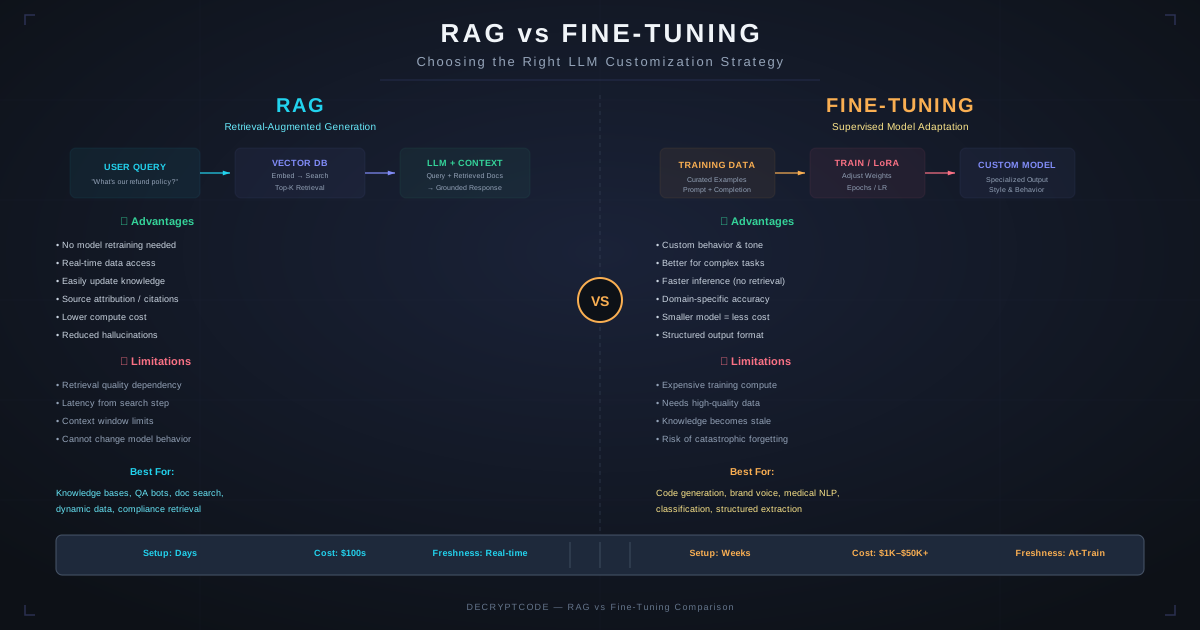
Key Takeaways
- RAG adds knowledge (facts, documents, data) — fine-tuning changes behavior (style, reasoning patterns, output format)
- RAG is faster to implement (2-4 weeks), lower cost ($15K-$60K), and easier to update
- Fine-tuning delivers better results for domain-specific reasoning, consistent formatting, and custom workflows
- The combination (fine-tuned model + RAG) outperforms either approach alone by 15-25% on enterprise benchmarks
- Start with RAG first — only fine-tune when you hit retrieval quality ceilings or need behavioral changes
The Core Difference
RAG and fine-tuning solve fundamentally different problems:
RAG (Retrieval-Augmented Generation) gives the model access to external knowledge at inference time. The model's weights don't change — it receives relevant documents in its context window and generates responses grounded in those documents. Think of it as giving the model a reference library.
Fine-tuning modifies the model's weights using your training data. The model learns new patterns, behaviors, and domain-specific reasoning. Think of it as teaching the model a new skill.
The confusion happens because both can make a model "know" about your domain. But they do it differently: RAG provides facts at query time; fine-tuning embeds patterns into the model itself.
RAG Deep Dive
How It Works
- Ingest: Your documents are chunked, embedded (converted to vectors), and stored in a vector database
- Retrieve: When a user asks a question, the query is embedded and matched against document vectors to find the most relevant chunks
- Generate: The retrieved chunks are included in the LLM prompt as context, and the model generates a response grounded in that context
RAG Strengths
- Real-time data: Knowledge updates instantly when documents change — no retraining required
- Source attribution: Every response can cite its source documents, enabling verification
- Data privacy: Your data stays in your infrastructure — the base model doesn't need access to training data
- Lower cost: No GPU clusters for training. Main cost is embedding computation and vector DB hosting
- Model-agnostic: Switch base models without rebuilding your knowledge pipeline
RAG Limitations
- Retrieval quality ceiling: If the retriever doesn't find the right documents, the model can't generate good answers
- Context window constraints: Limited to how much context fits in the model's context window
- No behavioral changes: RAG can't teach the model a new writing style or reasoning pattern
- Latency overhead: Retrieval adds 200-500ms to each request
Learn more: Our RAG pipeline development services
Fine-Tuning Deep Dive
How It Works
- Prepare data: Create training examples (input/output pairs) that demonstrate the desired behavior — typically 500-10,000 examples
- Train: Run supervised training on the base model using your examples. This modifies model weights to encode new patterns
- Evaluate: Test the fine-tuned model against held-out examples and production benchmarks
- Deploy: Serve the fine-tuned model via API or self-hosted infrastructure
Fine-Tuning Strengths
- Behavioral changes: Model adopts your tone, formatting, terminology, and reasoning patterns
- Consistent output: Reliably produces outputs in specific formats (JSON schemas, report templates, clinical notes)
- Domain reasoning: Improved performance on domain-specific logic that base models struggle with
- Reduced prompting: Less elaborate prompts needed — the model "already knows" the expected behavior
- Cost reduction: Fine-tuned smaller models can match larger base model performance at lower inference cost
Fine-Tuning Limitations
- Data requirements: Need 500-10,000 high-quality training examples, which require subject-matter expert time
- Static knowledge: Updates require retraining (hours to days of GPU compute)
- Catastrophic forgetting: Fine-tuning can degrade the model's general capabilities if not done carefully
- Higher cost: GPU compute for training ($5K-$50K+), plus ongoing retraining for updates
Learn more: Our LLM fine-tuning services
Side-by-Side Comparison
| Factor | RAG | Fine-Tuning |
|---|---|---|
| Implementation time | 2-4 weeks | 4-8 weeks |
| Initial cost | $15K-$60K | $40K-$150K |
| Knowledge updates | Minutes (re-index documents) | Hours-days (retrain model) |
| Data requirements | Raw documents | Curated input/output pairs |
| Factual accuracy | High (grounded in docs) | Medium (knowledge cutoff) |
| Output consistency | Medium | High |
| Domain reasoning | Limited improvement | Significant improvement |
| Source attribution | Yes (built-in) | No (must be engineered) |
| Infrastructure | Vector DB + API | GPU cluster + model hosting |
| Model portability | High (switch models easily) | Low (tied to specific model) |
Decision Framework
Choose RAG when:
- You need answers grounded in frequently changing documents
- Source attribution and verifiability are requirements
- You're working with a large corpus (10K+ documents)
- You want to ship quickly with lower initial investment
- Your primary need is "give the model knowledge it doesn't have"
Choose fine-tuning when:
- You need the model to follow a specific output format consistently
- Domain-specific reasoning is required (medical, legal, financial)
- You want to reduce prompt length and inference cost
- The model needs to adopt your organization's terminology and tone
- Your primary need is "change how the model behaves"
Choose both when:
- You need domain-specific reasoning AND real-time factual grounding
- The fine-tuned model needs access to current data
- You're building a production system where accuracy and consistency both matter
Combining RAG + Fine-Tuning
The most effective enterprise approach uses both: fine-tune for behavior, RAG for knowledge.
In our compliance review system, we fine-tuned the model to understand regulatory reasoning patterns and output compliance reports in the client's standard format. RAG provided the actual regulatory text and precedent rulings at query time. The combination achieved 94.2% accuracy — 12% higher than RAG alone and 18% higher than fine-tuning alone.
Best practice: Start with RAG. Measure performance. If you hit ceilings in output quality, consistency, or domain reasoning, add fine-tuning. This staged approach validates the use case before making the larger fine-tuning investment.
Cost Analysis
| Cost Component | RAG | Fine-Tuning | Combined |
|---|---|---|---|
| Initial build | $15-60K | $40-150K | $50-180K |
| Monthly infra | $500-3K | $2-10K | $3-12K |
| Updates | $500/month | $5-15K/retrain | $2-8K/month |
| Team required | ML engineer + DevOps | ML engineer + domain expert | Full ML team |
Implementation Considerations
RAG Implementation Priorities
- Chunking strategy — chunk size and overlap significantly impact retrieval quality
- Embedding model selection — domain-specific embeddings outperform general-purpose by 10-20%
- Hybrid retrieval — combine vector search with keyword search (BM25) for best results
- Reranking — use a cross-encoder to re-score top results before injecting into context
Read more: Advanced RAG patterns for production systems
Fine-Tuning Implementation Priorities
- Data quality over quantity — 500 excellent examples beat 5,000 mediocre ones
- Evaluation first — build your eval suite before training so you can measure improvement
- LoRA/QLoRA — parameter-efficient methods reduce compute cost by 70-90%
- Ablation testing — systematically test which training data categories drive the most improvement
Frequently Asked Questions
What is RAG?
RAG (Retrieval-Augmented Generation) retrieves relevant documents from a knowledge base and includes them in the LLM prompt as context. The model generates responses grounded in your data without modifying its weights.
When should I fine-tune instead of using RAG?
Fine-tune when you need the model to adopt a specific writing style, follow complex domain reasoning patterns, or consistently format outputs in a particular way. RAG handles factual knowledge; fine-tuning handles behavioral patterns.
Can I use both together?
Yes — the combination often delivers the best results. Fine-tune for domain reasoning and output formatting, then use RAG for real-time factual grounding. The fine-tuned model better understands how to use retrieved documents.
Build the Right LLM Architecture
We help enterprises choose between RAG, fine-tuning, or both — and build production-grade implementations.
Start a Project