
RAG for Enterprise LLMs: Scaling Knowledge Retrieval
Enterprise RAG isn't just bigger RAG — it requires multi-tenant architecture, document permission systems, governance controls, and performance optimization for millions of documents across hundreds of users.
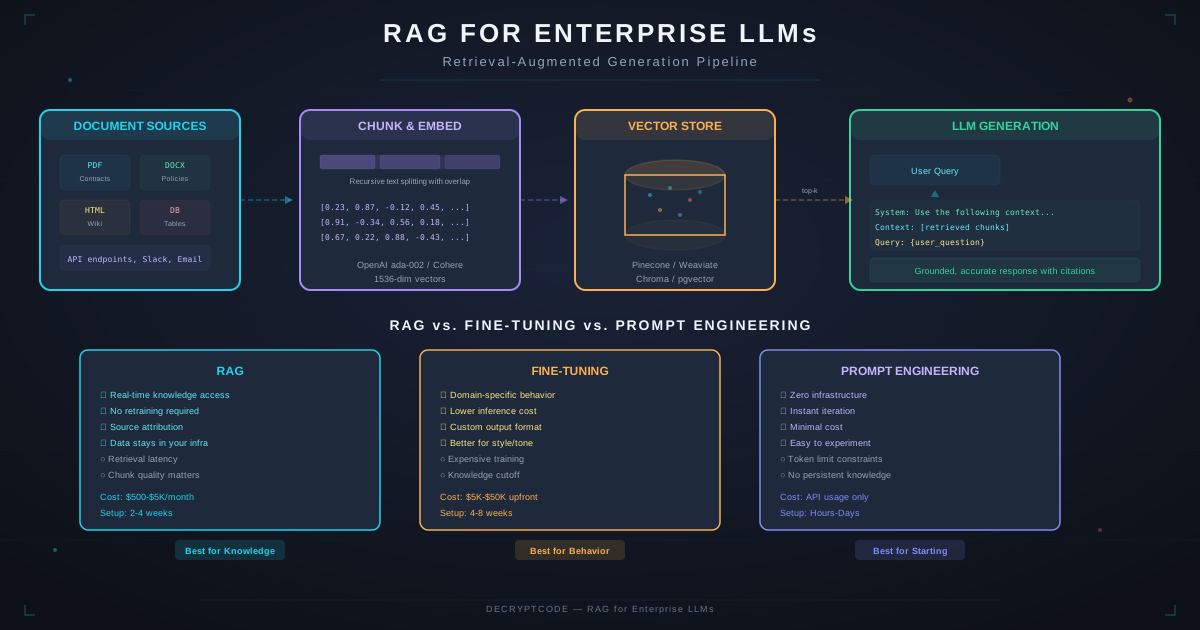
Key Takeaways
- Enterprise RAG requires document-level access control — not every user should see every retrieved document
- Multi-tenant vector stores isolate data by organization while sharing infrastructure for cost efficiency
- Ingestion pipelines must handle 50+ document formats, version control, and automatic refresh schedules
- Source attribution is mandatory — every AI answer must cite specific documents for audit compliance
- Performance at scale: sub-2-second p95 latency processing 10,000+ queries/day across millions of documents
Enterprise-Scale Challenges
Most RAG tutorials show a single-user system querying a small document set. Enterprise reality is different:
- Document volume: 100K-10M documents across dozens of sources (SharePoint, Confluence, S3, databases, email archives)
- User volume: Hundreds to thousands of concurrent users with different permission levels
- Data sensitivity: Documents contain PII, financial data, trade secrets, and regulated information
- Freshness requirements: Some documents update daily (regulatory filings, market data), others are static (policies, contracts)
- Audit requirements: Every answer must be traceable to source documents. "The AI said so" isn't acceptable to regulators.
These requirements fundamentally shape the architecture. Basic RAG won't work — you need enterprise-grade infrastructure.
Multi-Tenant Architecture
Multi-tenancy means multiple organizations or departments share the same infrastructure with complete data isolation:
Namespace Isolation
Each tenant gets its own namespace in the vector database. Documents are embedded and stored within the tenant's namespace. Retrievals only search within the authorized namespace(s). This prevents cross-tenant data leakage while sharing compute resources.
Shared vs. Dedicated Infrastructure
| Approach | Cost | Isolation | Best For |
|---|---|---|---|
| Shared namespace (metadata filter) | Low | Logical | Departments within same org |
| Separate namespaces | Medium | Strong logical | Business units, moderate sensitivity |
| Dedicated vector DB instances | High | Physical | Regulated industries, high sensitivity |
Most enterprises use separate namespaces (middle tier) — strong enough isolation for internal use while keeping infrastructure costs manageable.
Document Governance
Enterprise RAG needs document lifecycle management:
- Source Registry: Catalog of all document sources with owners, refresh schedules, and classification levels
- Version Control: When documents update, old embeddings must be replaced. Track document versions and ensure the index always reflects current versions.
- Retention Policies: Some documents must be removed from the index after expiration (regulatory filings, time-limited agreements). Automated purging based on metadata.
- Quality Scoring: Not all documents are equally authoritative. Tag documents with quality/authority scores (official policy = high, internal memo = medium, Slack thread = low). Weight retrieval scoring accordingly.
- Change Tracking: Log every document indexed, updated, and removed. Required for audit trails.
Access Control & Permissions
The most critical enterprise requirement: users should only see documents they're authorized to access.
Implementation Pattern
- Tag on Ingest: Every document chunk gets metadata: department, classification (public/internal/confidential/restricted), authorized roles, authorized users
- Filter on Retrieve: Query includes user's identity and permissions. Vector DB applies metadata filters before returning results
- Verify on Generate: Post-retrieval check confirms the user has access to every cited document
Permission Sources
Sync permissions from existing identity systems — LDAP/Active Directory groups, SharePoint permissions, custom RBAC systems. Don't build a separate permission system — mirror what already exists. Schedule permission syncs every 15-60 minutes to catch changes.
Ingestion at Scale
Enterprise document ingestion handles 50+ formats from dozens of sources:
Format Support
PDF, DOCX, PPTX, XLSX, HTML, Markdown, plain text, email (EML/MSG), images (OCR), audio (transcription), video (transcription), structured data (CSV, JSON, XML), databases (SQL queries).
Use specialized parsers per format. Common stack: Apache Tika for detection, Unstructured.io for parsing, Tesseract for OCR, Whisper for audio. Our Document AI services handle complex format challenges.
Chunking Strategy
Enterprise documents have complex structures — headers, tables, figures, footnotes, appendices. Semantic chunking (split by logical sections) outperforms fixed-size chunking by 15-20% on retrieval recall. Preserve document structure metadata (section headers, table captions) for context.
Pipeline Architecture
Event-driven ingestion: document changes trigger processing. Use a message queue (SQS, Kafka) to decouple source monitoring from processing. Auto-scale workers based on queue depth. Target throughput: 10,000+ documents/hour for initial bulk ingestion.
Performance Optimization
- Embedding Caching: Cache frequently queried embeddings. Reduce embedding API calls by 30-50%.
- Response Caching: Cache responses for semantically similar queries. Use embedding similarity threshold (>0.95) to detect near-duplicate questions. Reduces LLM API costs by 20-40%.
- Model Routing: Simple factual queries → fast/cheap model (GPT-4o-mini). Complex analytical queries → powerful model (GPT-4o, Claude Sonnet). Route based on query classification. Reduces cost by 40-60%.
- Pre-computation: For known high-value queries (common support questions, standard reports), pre-compute and cache answers during off-peak hours.
- Index Optimization: Use HNSW parameters tuned for your recall/latency trade-off. Higher ef_search = better recall but slower retrieval. Profile and tune per deployment.
Enterprise Model Selection
| Requirement | Cloud API | Self-Hosted |
|---|---|---|
| Data sovereignty | Region-locked endpoints | Full control |
| Latency | 100-500ms per call | 50-200ms per call |
| Cost at scale | Linear (pay per token) | Fixed (GPU infrastructure) |
| Compliance | BAA/DPA available | Full audit control |
| Model updates | Automatic (risk of regression) | Manual (predictable) |
Read more: Claude vs OpenAI for Enterprise
Compliance & Audit
- Source Attribution: Every AI response includes citations to specific documents, sections, and page numbers. Users can click through to verify.
- Decision Logging: Every retrieval query, retrieved documents, and generated response is logged with user identity and timestamp.
- Data Lineage: Track which documents contributed to which answers. Required for regulatory audits.
- Right to Deletion: When a document must be removed (GDPR, legal hold), purge it from all vector indices and caches within 24 hours.
- Regular Audits: Monthly accuracy assessments against human-evaluated test sets. Documentation of model versions, prompt templates, and configuration changes.
Case Study: Financial Compliance RAG
Our RAG compliance review system for a mid-sized financial services firm:
- Scale: 50,000+ regulatory documents across 12 jurisdictions
- Users: 200+ compliance analysts with role-based access
- Architecture: Hybrid retrieval, cross-encoder reranking, multi-namespace vector store
- Results: 87.5% faster review cycles, 96% accuracy, $480K annual savings
Ready to scale RAG for your enterprise? Explore our RAG services or contact our team.
Frequently Asked Questions
How do you handle document permissions in RAG?
Every document chunk is tagged with permission metadata. During retrieval, the query includes user permissions, and only authorized chunks are returned. This mirrors existing document management permissions.
How many documents can a RAG system handle?
Production systems routinely handle 1-10 million documents. Vector databases scale horizontally and support billions of vectors with sub-100ms retrieval. The practical limit is usually ingestion throughput, not retrieval performance.
Can RAG work with on-premise LLMs?
Yes. RAG is model-agnostic — the retrieval pipeline stays the same, only the generation step changes. Self-hosted Llama 3, Mistral, or fine-tuned variants work with any RAG architecture.
Scale RAG for Your Enterprise
Multi-tenant, permission-aware, compliance-ready RAG systems for regulated industries.
Start a Project