
GDPR AI Compliance: EU Data Protection for AI Systems
If your AI system processes personal data of EU residents, GDPR applies — regardless of where your company is based. This guide covers the key GDPR requirements for AI, Article 22 automated decision-making rules, DPIAs, and how the EU AI Act adds additional obligations.
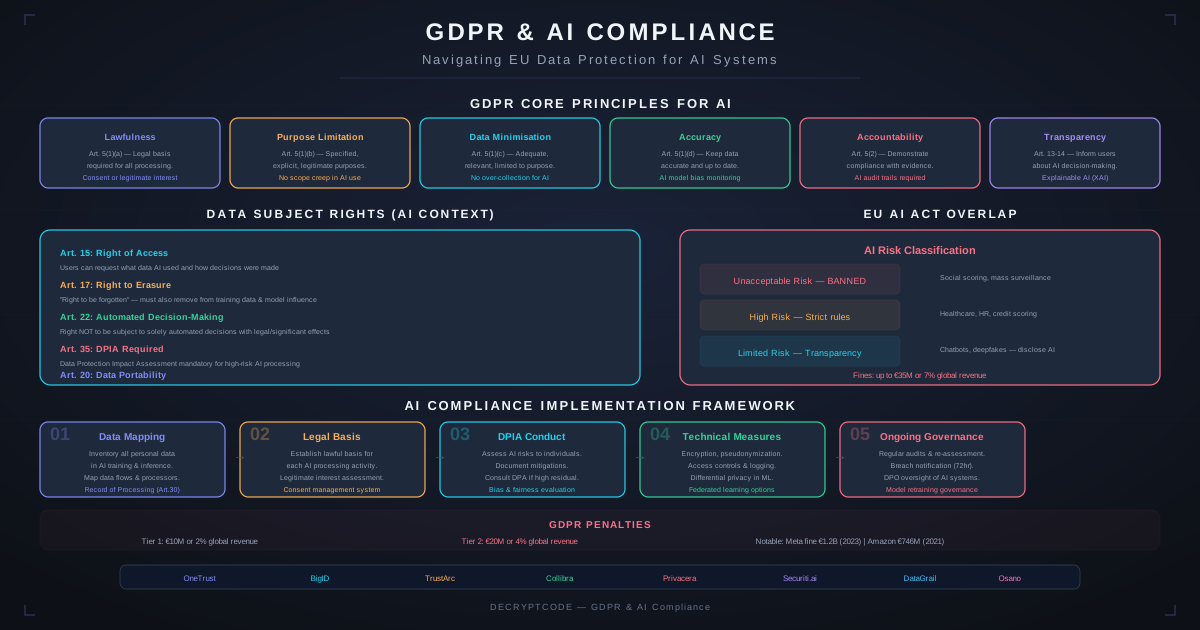
Key Takeaways
- GDPR applies to any AI system processing personal data of EU residents — extraterritorial scope
- Article 22 restricts purely automated decisions with legal/significant effects — human oversight required
- You need a lawful basis for AI training on personal data — legitimate interest typically, with balancing test
- Data subjects can request explanation of AI decisions and object to automated profiling
- EU AI Act adds risk-based requirements on top of GDPR for AI systems deployed in the EU
GDPR & AI Overview
GDPR (General Data Protection Regulation) regulates any processing of personal data of EU/EEA individuals. For AI systems, personal data appears in:
- Training data: Customer records, user behavior, communications used to train or fine-tune models
- Input data: User queries, uploaded documents, behavioral data fed to AI for inference
- Output data: AI-generated profiles, scores, predictions, and recommendations about individuals
- Derived data: Embeddings, feature vectors, and model weights that embed personal data patterns
Key GDPR principles applied to AI: purpose limitation (use data only for stated purposes), data minimization (process only necessary data), accuracy (keep AI training data correct and current), storage limitation (don't retain longer than necessary), and transparency (tell people how AI processes their data).
Lawful Basis for AI Processing
Every AI processing of personal data needs one of six lawful bases. Most common for AI:
Legitimate Interest (Article 6(1)(f))
Most flexible basis for AI. Requires a three-part balancing test:
- Purpose test: Is there a legitimate interest? (Yes — improving service quality, fraud detection, operational efficiency)
- Necessity test: Is AI processing necessary for this purpose? (Can you achieve the goal without personal data or with less data?)
- Balancing test: Does the interest override data subjects' rights? Consider: data sensitivity, expectations, relationship, safeguards applied
Consent (Article 6(1)(a))
Must be freely given, specific, informed, and unambiguous. Practical for consumer-facing AI (chatbots, recommendations). Problematic for employee or B2B use cases where consent may not be truly "free."
Contract (Article 6(1)(b))
If AI processing is necessary to fulfill a contract. Example: AI-powered service that the customer specifically signed up for. Cannot stretch this to cover training on customer data for general model improvement.
Article 22: Automated Decisions
GDPR's most AI-relevant provision. Article 22 gives individuals the right not to be subject to decisions based solely on automated processing that produce legal or similarly significant effects.
When Article 22 Applies
- AI-only credit scoring that determines loan approval or denial
- Automated hiring screening without human review
- AI-determined insurance pricing based on profiling
- Automated content moderation that restricts access to services
When Article 22 Does NOT Apply
- AI assists humans who make the final decision (human-in-the-loop)
- AI outputs are informational only (dashboards, recommendations with human action)
- No legal or similarly significant effect (product recommendations, content personalization)
Compliance Paths
- Human oversight: Ensure meaningful human involvement in significant decisions. Not rubber-stamping — genuine review capability.
- Explicit consent: Get specific consent for automated decision-making. Provide easy withdrawal mechanism.
- Contractual necessity: If automated processing is necessary to enter/perform a contract.
In all cases: provide meaningful information about the logic, significance, and consequences of the processing.
Data Subject Rights
AI systems must support these data subject rights:
- Right to Information: Privacy notices must explain AI processing — what data is used, for what purpose, and the logic of automated decisions.
- Right of Access: Individuals can request what personal data AI systems hold about them, including derived data and profiles.
- Right to Rectification: If AI uses incorrect data, individuals can request correction. AI systems must be able to update their data stores.
- Right to Erasure: "Right to be forgotten" — delete personal data from AI systems, including training data and derived embeddings where feasible.
- Right to Object: Individuals can object to profiling and processing based on legitimate interest. Must stop processing unless compelling grounds exist.
- Right to Explanation: For automated decisions under Article 22, individuals can request meaningful explanation of the decision logic and its significance.
Technical Implementation
- Data subject request handling system that covers AI data stores (vector databases, training datasets, model outputs)
- Erasure pipeline that removes personal data from embeddings, caches, and logs
- Explainability tooling that generates human-readable explanations of AI decisions
DPIA for AI Systems
A Data Protection Impact Assessment is mandatory when AI processing is likely to result in high risk to individuals. This includes most AI systems that profile or make decisions about people.
- Describe the processing: What personal data, what AI models, what decisions, what data flows
- Assess necessity: Is this processing necessary and proportionate to the purpose?
- Assess risks: What are the risks to individuals? Discrimination, privacy impacts, unfair treatment, lack of transparency
- Mitigation measures: How do you reduce risks? Anonymization, human oversight, bias testing, transparency, security controls
- Consult DPA: If high risk remains after mitigation, consult your supervisory authority before proceeding
Training Data Compliance
- Anonymization first: If you can truly anonymize data (irreversible, no re-identification risk), GDPR doesn't apply. Use k-anonymity, differential privacy, or synthetic data generation.
- Purpose limitation: Data collected for one purpose (customer service) can't automatically be used for another (model training) without a compatible purpose or new lawful basis.
- Data minimization: Train on the minimum data necessary. Don't include all customer fields when you only need interaction patterns.
- Retention: Don't keep training data indefinitely. Define retention periods and apply them to training datasets.
- Documentation: Maintain data lineage — which datasets were used, when, for which model version, under which lawful basis.
Cross-Border Transfers
If AI processing occurs outside the EU/EEA (common with US-based cloud providers):
- Adequacy decisions: Transfers to countries with adequate protection (EU-US Data Privacy Framework for certified US companies)
- Standard Contractual Clauses (SCCs): Contractual safeguards for transfers to non-adequate countries
- Data localization: Process EU personal data in EU regions. All major cloud providers offer EU region deployments.
- Supplementary measures: Encryption where cloud provider cannot access plaintext, pseudonymization before transfer
EU AI Act Interaction
The EU AI Act (effective 2025-2026) adds AI-specific requirements on top of GDPR:
| Risk Level | Examples | Requirements |
|---|---|---|
| Unacceptable | Social scoring, real-time biometric mass surveillance | Prohibited |
| High-Risk | Credit scoring AI, hiring AI, medical diagnostics | Conformity assessment, risk management, data governance, human oversight, transparency, logging |
| Limited Risk | Chatbots, emotion detection, deep fakes | Transparency obligations (disclose AI interaction) |
| Minimal Risk | Spam filters, content recommendations | Voluntary codes of conduct |
For enterprise AI: if your system falls under "high-risk," you need both GDPR compliance AND AI Act conformity assessment. The overlap areas: human oversight, transparency, data quality, and non-discrimination.
GDPR AI Compliance Checklist
- ☐ Lawful basis identified and documented for all AI processing
- ☐ Privacy notice covers AI processing, profiling, and automated decisions
- ☐ Article 22 assessment completed — human oversight where required
- ☐ DPIA conducted for high-risk AI processing
- ☐ Data subject rights supported (access, erasure, objection, explanation)
- ☐ Training data compliance verified (purpose, minimization, retention)
- ☐ Cross-border transfer mechanisms in place (SCCs, DPF, EU hosting)
- ☐ Vendor DPAs signed with all AI sub-processors
- ☐ Bias testing and fairness assessments documented
- ☐ EU AI Act risk classification assessed (if deploying in EU)
Need help with AI compliance? Explore our enterprise AI consulting services.
Frequently Asked Questions
Can I use personal data to train AI models?
Yes, with a lawful basis. Legitimate interest with proper balancing test is most common. Anonymized data falls outside GDPR entirely. A DPIA is required before training on personal data.
What is Article 22?
Article 22 gives individuals the right not to be subject to purely automated decisions with legal/significant effects. You must provide human oversight, obtain explicit consent, or demonstrate contractual necessity. Always provide meaningful explanation of the logic.
How does the EU AI Act interact with GDPR?
Both apply simultaneously. GDPR governs personal data processing; the AI Act governs AI system safety and transparency. High-risk AI systems need conformity assessments AND GDPR compliance.
Build GDPR-Compliant AI
From privacy impact assessments to production deployment — AI that respects data rights.
Start a Project