
Edge AI & On-Device Intelligence in 2026
Edge AI runs models directly on devices — phones, tablets, IoT sensors, embedded systems — eliminating cloud round-trips for faster inference, better privacy, and offline capability. This guide covers frameworks, model optimization, and architecture for on-device AI.
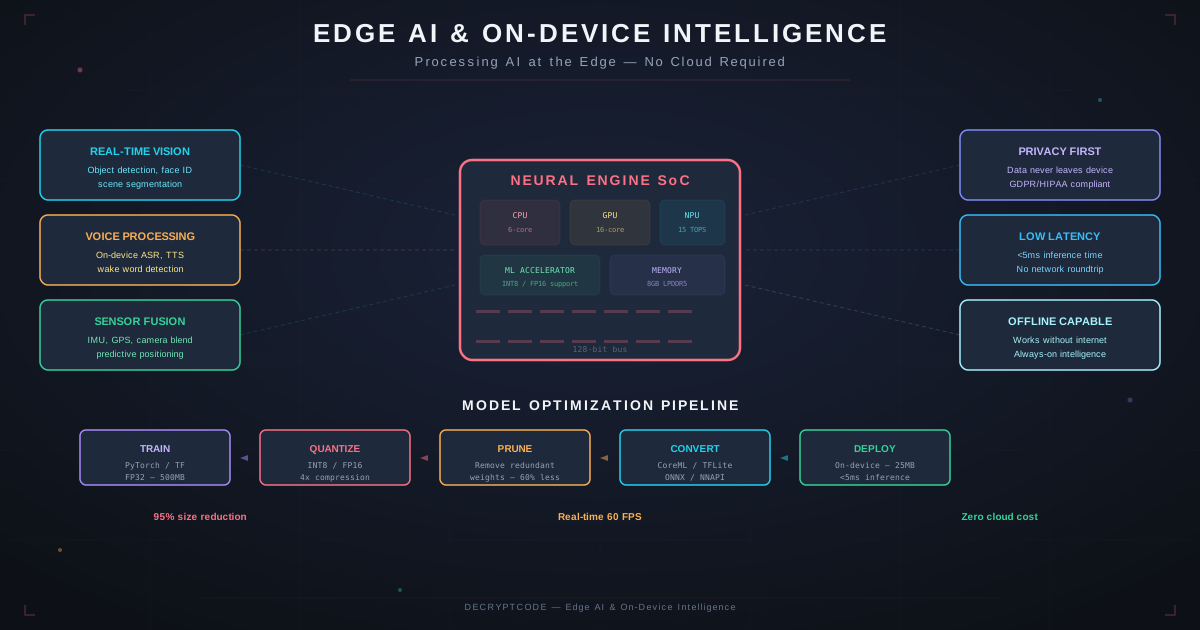
Key Takeaways
- Modern mobile NPUs (35-45+ TOPS) run classification, detection, and small LLMs at near-real-time speeds
- Core ML for iOS-only, TensorFlow Lite for cross-platform, ONNX Runtime for model portability
- Quantization (INT8/INT4) reduces model size 2-4x with <2% accuracy loss for most tasks
- On-device LLMs (1-3B params) handle text generation, summarization, and commands without cloud APIs
- Edge-cloud hybrid architecture is the production pattern — edge for latency/privacy, cloud for complexity
Why Edge AI
Running AI on-device instead of the cloud provides four key advantages:
- Latency: On-device inference eliminates 100-500ms+ network round trips. Image classification in 5-15ms vs. 200-500ms with cloud API. Enables real-time applications.
- Privacy: Data never leaves the device. Critical for HIPAA-regulated healthcare, financial, and personal applications. No PHI transmitted, no BAAs needed for on-device processing.
- Offline capability: Works without internet. Essential for field workers, remote areas, and environments with unreliable connectivity.
- Cost: No per-inference API costs. Once the model is deployed to the device, inference is free. At high query volumes, edge AI is dramatically cheaper than cloud APIs.
Device Hardware in 2026
| Platform | AI Accelerator | Performance | Key Capabilities |
|---|---|---|---|
| Apple A18/M4 | Neural Engine | 35 TOPS | Core ML integration, unified memory, efficient transformers |
| Qualcomm Snapdragon 8 Gen 4 | Hexagon NPU | 45+ TOPS | INT4 acceleration, on-device LLMs, multi-modal support |
| Google Tensor G5 | Edge TPU | 30+ TOPS | TFLite optimization, Gemini Nano integration |
| MediaTek Dimensity 9400 | APU 7.0 | 40+ TOPS | Generative AI acceleration, NeuroPilot SDK |
TOPS = Tera Operations Per Second. These NPUs are specifically designed for matrix multiplication and neural network inference, running 10-100x more efficiently than GPU or CPU for AI workloads.
Framework Comparison
Core ML (Apple)
- Platform: iOS, iPadOS, macOS, watchOS, visionOS
- Strengths: Automatic Neural Engine/GPU/CPU dispatch, tight SwiftUI integration, privacy labels, model encryption
- Model formats: .mlmodel, .mlpackage (with weights)
- Converter: coremltools converts from PyTorch, TensorFlow, ONNX
- Best for: iOS-only apps, maximum Apple hardware utilization
See our Core ML vs TensorFlow Lite deep dive for detailed comparison.
TensorFlow Lite
- Platform: Android, iOS, Linux, microcontrollers
- Strengths: Largest model zoo (TF Hub), GPU/NNAPI delegates, mature ecosystem
- Model format: .tflite (FlatBuffer)
- Converter: TFLite Converter from TensorFlow SavedModel/Keras
- Best for: Cross-platform mobile, Android-first applications
ONNX Runtime
- Platform: Android, iOS, Windows, Linux, Web (WASM)
- Strengths: Framework-agnostic (import from PyTorch, TF, scikit-learn), good optimization passes, NNAPI/CoreML execution providers
- Model format: .onnx
- Best for: Models trained in any framework, complex model conversions
MediaPipe (Google)
- Platform: Android, iOS, Web, Python
- Strengths: Pre-built solutions (face, hands, pose, object detection), real-time video processing pipelines
- Best for: Computer vision applications with pre-built task APIs
Model Optimization
Making models small and fast enough for mobile devices:
Quantization
- FP32 → FP16: 2x size reduction, minimal accuracy loss. Default first step.
- FP32 → INT8: 4x size reduction, <1-2% accuracy loss for most tasks. Post-training quantization (easiest) or quantization-aware training (best quality).
- FP32 → INT4: 8x size reduction, 2-5% accuracy loss. Essential for on-device LLMs. Modern NPUs accelerate INT4 natively.
Pruning
Remove unimportant weights (near-zero values). Structured pruning removes entire channels/layers for hardware-friendly speedup. Unstructured pruning is more flexible but requires sparse computation support.
Knowledge Distillation
Train a small "student" model to mimic a large "teacher" model. The student learns the teacher's output distribution, not just the correct labels. Result: small models with accuracy approaching large models.
Architecture-Specific Models
MobileNet, EfficientNet, and MobileViT are designed from scratch for mobile inference. They use depthwise separable convolutions and attention optimizations that run efficiently on mobile hardware.
On-Device LLMs
Small language models (1-3B parameters) now run on flagship devices:
- Apple Foundation Models: Apple's on-device models for text generation, summarization, and Siri intelligence. Deeply integrated with Core ML.
- Gemini Nano: Google's on-device model for Pixel devices. Handles summarization, smart replies, and local question answering.
- Phi-3/Phi-4 Mini: Microsoft's small models (3.8B params) that run on-device with INT4 quantization.
- Llama 3.2 1B/3B: Meta's open models specifically designed for on-device deployment.
On-Device LLM Capabilities
- Text summarization and key point extraction
- Simple Q&A over local documents
- Form auto-fill and data extraction
- Natural language commands and intent classification
- Local chat/assistant without cloud connectivity
Limitations: On-device models sacrifice reasoning depth for speed. Complex multi-step reasoning, large knowledge retrieval, and code generation still benefit from cloud models.
Use Cases
- Healthcare: On-device medical image analysis (skin lesion classification, retinal screening) with no PHI transmission. Point-of-care diagnostics in rural areas.
- Field Inspection: Infrastructure inspection (cracks, corrosion, equipment damage) with offline detection models.
- Insurance: On-device damage assessment from claim photos — instant classification and severity scoring. See our mobile insurance claims case study.
- Document Processing: On-device OCR + data extraction for forms, receipts, ID documents. No sensitive documents leave the device.
- Real-Time Translation: On-device neural machine translation for fieldworkers, travelers, and multilingual environments.
- AR Experiences: Real-time object detection, scene understanding, and gesture recognition for AR mobile applications.
Edge-Cloud Architecture
Production systems rarely use edge-only or cloud-only. The hybrid pattern:
- Edge Tier (on-device): Real-time inference for latency-sensitive tasks, pre-processing, filtering, and local caching of model outputs
- Fog Tier (local server/gateway): Aggregation, medium-complexity models, local data storage, edge-cloud synchronization
- Cloud Tier: Complex reasoning (large LLMs), model training, global analytics, model distribution
Decision routing: Simple tasks (classification, detection) run on-device. Medium tasks (entity extraction, summarization) run on-device if compute allows, else cloud. Complex tasks (multi-step reasoning, large RAG) always cloud.
Model Update Strategy
- OTA model updates via background download when on Wi-Fi
- A/B testing: deploy new models to percentage of devices, monitor quality metrics
- Fallback: keep previous model version on-device for instant rollback
- Differential updates: send only weight differences for faster, smaller downloads
Challenges & Solutions
- Device fragmentation: Not all devices have NPUs. Solution: runtime capability detection, fallback to GPU/CPU delegates with appropriate model sizes.
- Battery impact: Continuous AI inference drains batteries. Solution: batch processing, event-driven inference (run only when needed), power-aware scheduling.
- Model size vs. accuracy: Aggressive compression hurts quality. Solution: calibrated quantization benchmarks, task-specific evaluation suites, accept lower accuracy for non-critical tasks.
- Testing complexity: Must test across device tiers. Solution: device farm testing (Firebase Test Lab, BrowserStack), automated performance benchmarks.
Explore our iOS development and Android development services for edge AI implementation.
Frequently Asked Questions
What models can run on mobile devices in 2026?
Small LLMs (1-3B params with INT4 quantization), image classification/detection, speech recognition, OCR, and pose estimation. Apple Neural Engine handles 35 TOPS, Qualcomm Hexagon 45+ TOPS.
How much does edge AI reduce latency?
Eliminates 100-500ms+ network round-trips. On-device: image classification 5-15ms, object detection 20-50ms, small LLM generation 30-80ms per token.
Core ML vs TensorFlow Lite vs ONNX?
Core ML for iOS-only (best Apple hardware utilization). TensorFlow Lite for cross-platform (largest model zoo). ONNX Runtime for converting models from any training framework.
Build Edge AI Solutions
On-device intelligence for mobile, IoT, and embedded systems — from model optimization to production deployment.
Start a Project