
AI Voice Agents for Business: Vapi AI, Bland, and Custom LLM Phone Agents
Voice AI is crossing the threshold from demo to production. This guide covers the full stack — STT, LLM routing, TTS, telephony, and the platform choices that determine whether your voice agent feels like sci-fi or like a bad IVR replacement.
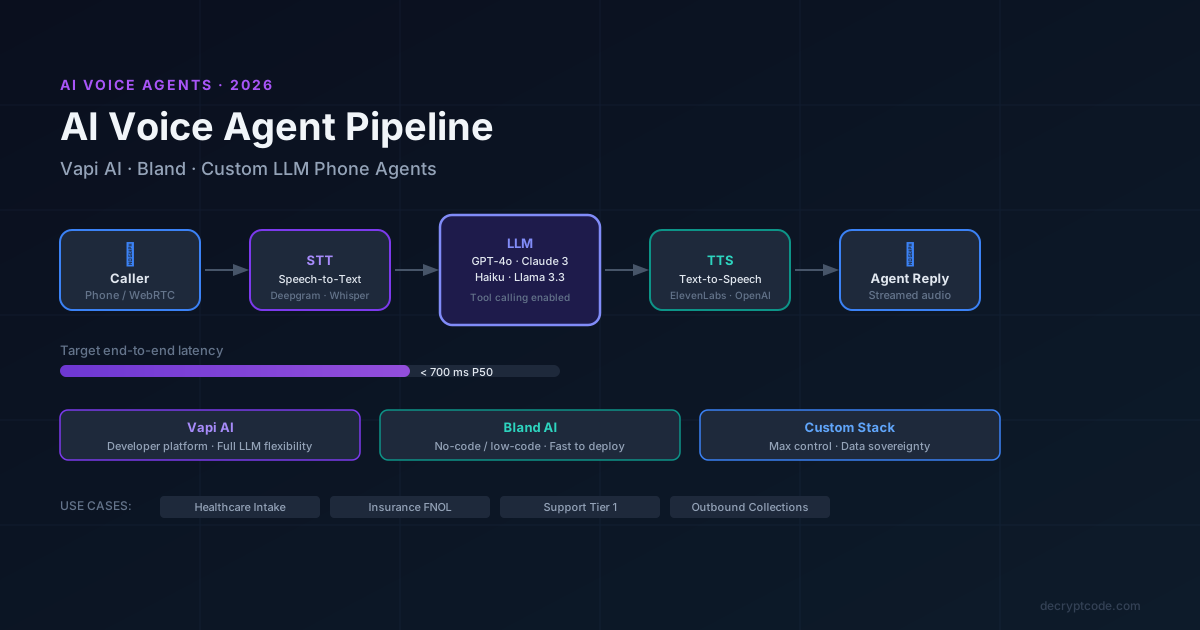
Table of Contents
What Is an AI Voice Agent?
An AI voice agent is a system that conducts full telephone conversations autonomously. Unlike traditional interactive voice response (IVR) trees, a voice agent understands natural language, adapts dynamically to what the caller says, and takes actions in connected systems — booking appointments, updating CRM records, triaging support tickets — without a human on the line.
The 2025–2026 generation of voice agents is powered by low-latency large language models combined with streaming speech-to-text and neural text-to-speech. The result: conversations that feel fluent and responsive rather than robotic and rigid.
Pipeline Anatomy: STT → LLM → TTS
Every voice agent pipeline has five stages:
- Telephony / Transport — Inbound call handling via SIP trunk or WebRTC. Platforms: Twilio, Vonage, Telnyx, or Vapi's managed number pool.
- Speech-to-Text (STT) — Converts caller audio to text in real time. Leading options: Deepgram Nova-3, OpenAI Whisper Large, AssemblyAI Streaming.
- LLM Reasoning — Processes transcribed text, maintains conversation state, and decides on next action or response. Models: GPT-4o (fastest), Claude 3.5 Sonnet (best instruction-following), Llama 3.3 70B (on-prem).
- Text-to-Speech (TTS) — Converts LLM output to audio. Leading options: Eleven Labs Turbo v2, OpenAI TTS-1, PlayHT 2.0.
- Tool Calling / Actions — The LLM triggers function calls mid-conversation: calendar lookup, CRM write, form submission, escalation to human.
Streaming Is Non-Negotiable
All three AI stages must stream. If you wait for the full LLM response before starting TTS synthesis, you add 1–3 seconds of silence. The correct architecture starts TTS as soon as the first sentence is complete — using sentence-boundary detection on the streaming LLM output.
The Latency Problem
Humans tolerate roughly 800 ms of silence before a conversation feels broken. Budget your latency across the pipeline:
| Stage | Target Latency | Notes |
|---|---|---|
| STT first token | 50–150 ms | Deepgram streaming, partial results |
| LLM first token | 150–400 ms | GPT-4o or Claude 3 Haiku; avoid o1/o3 for voice |
| TTS first audio | 80–150 ms | Eleven Labs Turbo v2 or Deepgram Aura |
| Network (round-trip) | 30–80 ms | Co-locate LLM and TTS in same cloud region |
| Total P50 target | < 700 ms | Aim for 500 ms on fast paths |
Interrupt Handling
Users interrupt agents constantly. Your pipeline needs barge-in detection: when the STT detects the caller speaking while TTS is playing, stop audio playback immediately and process the new utterance. Failure to handle barge-in is the single biggest reason voice agents feel robotic.
Platform Comparison: Vapi vs. Bland vs. Custom Stack
| Factor | Vapi AI | Bland AI | Custom Stack |
|---|---|---|---|
| Target audience | Developers | Non-technical / SMB | Engineering teams |
| LLM flexibility | Any (OpenAI, Anthropic, Groq) | Managed (limited) | Any |
| STT / TTS choice | Configurable | Managed | Full control |
| Latency control | High | Low | Maximum |
| Time to first call | Hours | Minutes | Weeks |
| HIPAA BAA available | Yes (enterprise plan) | Check current docs | Your responsibility |
| Pricing model | Per-minute + infra | Per-minute | Infra cost only |
| Best for | Production enterprise | Quick demos / SMB | High-volume / sensitive data |
When to Build Custom
For most enterprises, Vapi is the right starting point. Build custom only when: (1) you process PHI/PII and want full data sovereignty, (2) call volume exceeds 100K minutes/month and per-minute pricing becomes prohibitive, or (3) you need proprietary on-device STT for offline environments.
Enterprise Use Cases That Ship Today
- Healthcare intake — Pre-visit symptom collection, insurance verification, appointment reminders. Our Synapse Orthopedic case study: 0 minutes of staff time per intake.
- Insurance first notice of loss (FNOL) — Automated claim intake, guided damage description, policy lookup, adjuster routing.
- Customer support Tier 1 — Account lookup, order status, password reset, FAQ resolution — deflecting 40–60% of inbound volume.
- Outbound collections — Compliant payment reminders with live payment capture via DTMF or spoken card numbers (PCI-DSS scope applies).
- HR / internal help desk — Benefits questions, PTO balance, IT ticket creation, employee onboarding FAQs.
HIPAA and Compliance Considerations
Voice AI in healthcare is a Business Associate Agreement (BAA) chain problem. Every vendor that processes or stores audio containing PHI must sign a BAA: your telephony provider, your STT vendor, your LLM provider, and your TTS provider.
- Twilio — Signs BAA on Healthcare plans
- Deepgram — Signs BAA; deploy in HIPAA-eligible environment
- OpenAI — Signs BAA on Enterprise tier; data processed but not trained on
- Anthropic / Claude — BAA available on commercial API
- Vapi — Enterprise plan includes BAA; confirm data residency region
Beyond BAAs: encrypt call recordings at rest (AES-256), purge transcripts after the retention period required by state law, and log all PHI access for audit trails.
Production Checklist
- ✅ Sub-800 ms P50 end-to-end latency tested on target geography
- ✅ Barge-in / interruption handling implemented and tested
- ✅ Fallback to human agent on confidence below threshold
- ✅ Call recording consent prompt (state-specific — two-party consent states)
- ✅ BAAs signed with all PHI-handling vendors (if healthcare)
- ✅ PII/PHI redacted from logs before storage
- ✅ Load-tested at 5× expected peak concurrent calls
- ✅ Drift monitoring — weekly review of call transcripts for accuracy regression
- ✅ Escalation path to live agent always available
Frequently Asked Questions
An AI voice agent is a software system that conducts natural telephone conversations autonomously using a pipeline of speech-to-text (STT), a large language model (LLM), and text-to-speech (TTS). Unlike traditional IVR, it understands intent, handles interruptions, asks follow-up questions, and takes actions in backend systems — all in real time.
Vapi is a developer platform for building and deploying AI voice agents. It provides a managed orchestration layer that handles WebRTC/SIP transport, low-latency TTS/STT, function calling to external APIs, and conversation state — so you can focus on the LLM prompt and business logic rather than telephony infrastructure.
Vapi targets developers and offers the most flexibility — bring your own LLM, STT, and TTS providers, with fine-grained control. Bland AI targets non-technical users with a no-code/low-code interface and managed infrastructure. Vapi wins on customization; Bland wins on time-to-first-call. For enterprise-grade, compliant deployments, Vapi's flexibility is usually preferable.
End-to-end latency (user stops speaking → agent starts speaking) should be under 800 ms to feel natural. The main contributors are STT (50–150 ms), LLM first-token latency (200–600 ms), and TTS (50–150 ms). Streaming responses from all three components and using fast models like GPT-4o or Claude 3 Haiku is essential.