
AI Automation ROI Calculator: Measure Real Returns
Most AI automation ROI projections are fantasy. This framework shows you how to calculate real returns — using actual cost data, conservative assumptions, and metrics that CFOs trust.
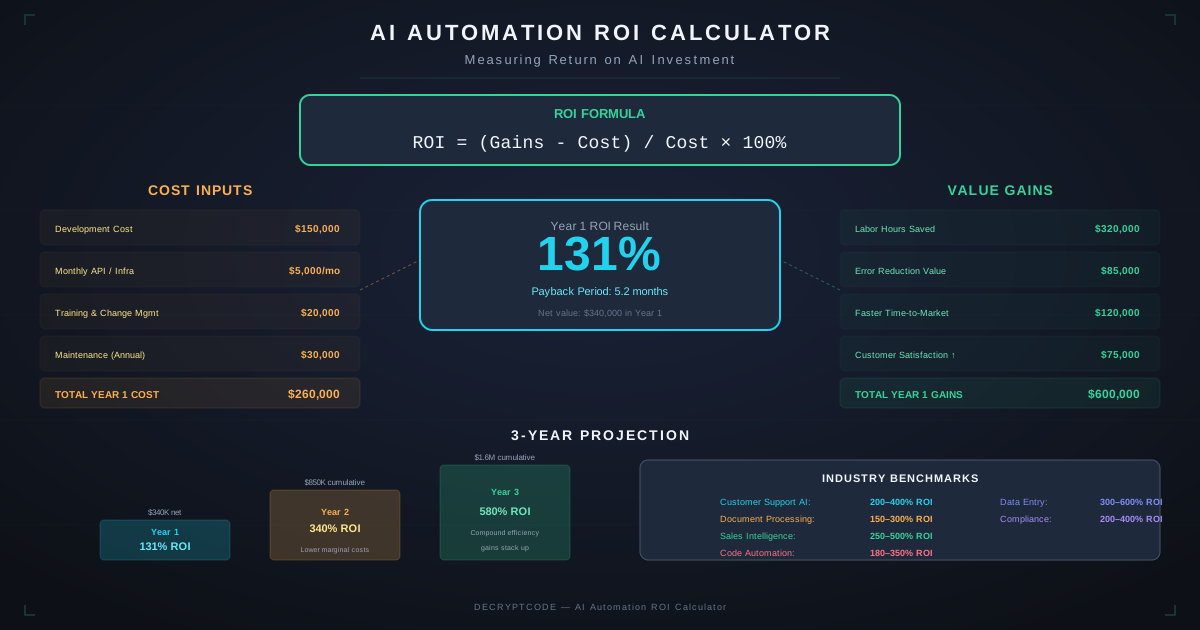
Key Takeaways
- ROI = (Annual Benefits - Annual Costs) / Total Investment × 100
- Three primary benefit categories: time savings (60-80% of ROI), error reduction (15-25%), throughput gains (10-20%)
- Include ALL costs: build, infrastructure, API, maintenance, training, and opportunity cost
- Typical enterprise AI payback: 6-18 months. Simple automation: 3-8 months
- Use conservative assumptions (50-70% of projected savings) for credible stakeholder presentations
The ROI Formula
Enterprise AI automation ROI calculation:
Annual Benefits = Time Savings + Error Reduction Value + Throughput Gain Value + Indirect Benefits
Total Investment = Build Cost + Year 1 Operating Costs
Annual Operating Costs = Infrastructure + API Costs + Maintenance + Training
First-Year ROI = (Annual Benefits - Annual Operating Costs - Build Cost) / Build Cost × 100
Ongoing ROI = (Annual Benefits - Annual Operating Costs) / Annual Operating Costs × 100
The key distinction: first-year ROI includes the build investment (often negative or break-even). Ongoing ROI reflects the steady-state return (typically 200-500% for well-implemented automation).
Benefit Categories
| Category | Typical % of ROI | Measurement Method |
|---|---|---|
| Time savings | 60-80% | Hours saved × fully-loaded hourly rate |
| Error reduction | 15-25% | Errors prevented × cost per error |
| Throughput gains | 10-20% | Additional output × value per unit |
| Indirect benefits | 5-15% | Employee satisfaction, faster decisions |
Only include indirect benefits if you can credibly quantify them. For stakeholder presentations, lead with hard numbers. Indirect benefits are supporting evidence, not the primary case.
Total Cost of Ownership
| Cost Component | One-Time | Annual | Notes |
|---|---|---|---|
| Build/Development | $50-250K | — | Varies by complexity |
| Infrastructure | $5-20K setup | $12-60K | Cloud, vector DB, compute |
| LLM API costs | — | $6-120K | Based on query volume |
| Maintenance | — | $24-60K | 15-25% of build cost annually |
| Training/Change Mgmt | $5-15K | $3-8K | User training, documentation |
| Monitoring/Observability | — | $3-12K | Logging, alerting, dashboards |
Common mistake: underestimating ongoing costs. LLM API costs scale with usage. Maintenance is not optional — models drift, APIs change, requirements evolve. Budget 20% of build cost annually for maintenance.
Calculating Time Savings
The largest ROI driver. Use this formula per automated task:
Annual Time Savings = (Manual Time per Task - Automated Time per Task) × Frequency per Year × Number of Workers
Dollar Value = Annual Hours Saved × Fully-Loaded Hourly Rate
Example: Document Review
- Manual: 45 minutes per document
- AI-assisted: 10 minutes per document (AI does initial review, human verifies)
- Frequency: 200 documents per month
- Workers: 8 compliance analysts
- Hourly rate: $85 (fully loaded)
Savings: 35 min × 200/month × 12 = 1,400 hours/year. Value: 1,400 × $85 = $119,000/year in time savings alone.
Our compliance review RAG system achieved 86% time reduction — exceeding the typical 60-80% range.
Error Reduction Value
Annual Error Value = (Current Error Rate - AI Error Rate) × Total Transactions × Cost per Error
Cost per Error by Type
| Error Type | Typical Cost | AI Reduction |
|---|---|---|
| Data entry error | $50-200 | 85-95% |
| Missed compliance item | $5,000-50,000 | 60-80% |
| Incorrect classification | $200-2,000 | 70-90% |
| Missed SLA | $500-5,000 | 50-70% |
| Regulatory violation | $10,000-1,000,000+ | 40-60% |
Use conservative error reduction percentages (lower end of ranges). A single prevented regulatory violation can justify the entire AI investment.
Throughput Gains
AI automation often enables processing volumes that weren't possible with human-only workflows:
Value = (New Throughput - Previous Throughput) × Revenue or Value per Unit
Example: Insurance Claims Processing
Before AI: 500 claims/day with 12 adjusters. After AI: 2,000 claims/day with same team. Additional capacity: 1,500 claims/day. If each claim generates $50 in processing value: 1,500 × $50 × 250 working days = $18.75M additional annual capacity.
Our insurance claims automation increased throughput from 8 to 47 claims per adjuster per day.
Payback Period Analysis
| Project Type | Build Cost | Annual ROI | Payback Period |
|---|---|---|---|
| Document processing | $50-80K | $100-250K | 3-8 months |
| Customer support AI | $80-150K | $200-500K | 4-9 months |
| Compliance automation | $100-200K | $250-1M+ | 6-12 months |
| Multi-agent workflows | $150-300K | $400K-2M+ | 8-18 months |
| Predictive operations | $200-400K | $500K-5M+ | 6-18 months |
Most projects break even within 12 months. Conservative projections (using 60% of estimated benefits) still show payback within 18 months for well-scoped projects.
Industry ROI Examples
Healthcare: EHR Data Onboarding
Our EHR automation: $180K investment → $2M annual savings. First-year ROI: 456%. Payback: 3 months.
Financial Services: Compliance Review
LLM contract analysis system: $120K investment → $480K annual savings. First-year ROI: 300%. Payback: 4 months.
Insurance: Claims Processing
AI claims processing: $250K investment → $28M annual impact. First-year ROI: 11,100%. Payback: 5 weeks.
Ready to calculate your AI automation ROI? Contact us for a free assessment or explore our AI workflow automation services.
Frequently Asked Questions
How do I calculate AI automation ROI?
ROI = (Annual Benefits - Annual Costs) / Total Investment × 100. Benefits include time savings (hours saved × hourly cost), error reduction (errors prevented × cost per error), and throughput gains.
What's a typical payback period?
6-18 months for most enterprise AI. Simple automation (document processing) pays back in 3-8 months. Complex multi-agent systems take 12-24 months but deliver higher long-term ROI.
What metrics should I track?
Hard metrics: hours saved, error rate reduction, throughput increase, cost per transaction. Soft metrics: employee satisfaction, response time, compliance adherence. Hard metrics drive the business case; soft metrics sustain buy-in.
Get Your Free AI ROI Assessment
We'll analyze your workflows, estimate savings, and build a credible ROI case for your stakeholders.
Get Assessment