
How Much Does Enterprise AI Agent Development Cost in 2026?
Enterprise AI agent development costs range from $50K for a single-purpose agent to $500K+ for multi-agent systems with enterprise integrations. Here's what drives pricing and how to budget accurately.
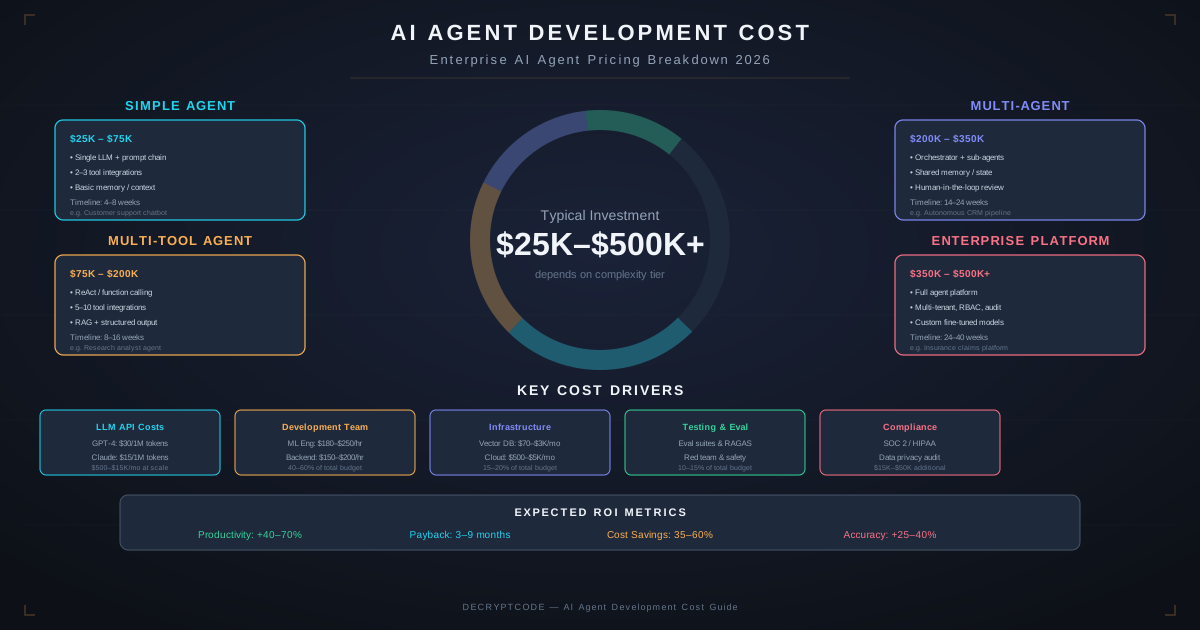
Key Takeaways
- Single AI agents cost $40K–$80K; multi-agent systems run $200K–$500K+
- LLM API costs are 40-60% of ongoing operational expenses
- Enterprise integrations (CRM, EHR, ERP) add $30K–$80K per system
- Compliance requirements (HIPAA, SOC2) add 25-40% to total cost
- Typical payback period: 4-8 months for well-scoped projects
Quick Answer: AI Agent Cost Ranges
Enterprise AI agent development cost in 2026 depends primarily on system complexity, integration requirements, and compliance needs. Here are the typical ranges we see across our projects:
| Agent Type | Development Cost | Timeline | Monthly Opex |
|---|---|---|---|
| Single-Purpose Agent | $40K–$80K | 6-10 weeks | $2K–$5K |
| Multi-Tool Agent | $80K–$150K | 8-14 weeks | $5K–$10K |
| Multi-Agent System | $200K–$500K | 16-24 weeks | $8K–$20K |
| Enterprise Multi-Agent + Compliance | $400K–$800K+ | 20-32 weeks | $15K–$40K |
These ranges assume US-based development teams with AI/ML expertise. Offshore teams can reduce development costs by 40-60%, but we've seen this increase total project cost by 20-30% due to rework, communication overhead, and quality gaps in AI-specific engineering.
7 Factors That Drive AI Agent Costs
1. Agent Complexity & Autonomy Level
The biggest cost driver is how much autonomous decision-making the agent performs. A simple classifier agent that routes support tickets costs a fraction of a multi-agent CRM system that scores leads, drafts emails, and manages pipeline stages.
Autonomy requires more sophisticated error handling, guardrails, human-in-the-loop flows, and testing. Each decision point the agent can make independently adds engineering effort for edge cases and failure modes.
2. Number of Tool Integrations
Each external system the agent interacts with—CRM, database, API, file system, email—requires a tool definition, authentication handling, error management, and testing. Budget $8K–$15K per tool integration for production-quality implementations.
Common integrations and their typical costs:
- Salesforce/HubSpot CRM: $15K–$25K (complex APIs, rate limits, data mapping)
- Database (PostgreSQL, MongoDB): $5K–$10K (query generation, schema awareness)
- Email (SendGrid, SES): $5K–$8K (template management, personalization)
- Document Processing: $10K–$20K (OCR, parsing, extraction pipelines)
- EHR Systems (Epic, Cerner): $25K–$40K (FHIR APIs, certification, compliance)
3. LLM Selection & Fine-Tuning
Using GPT-4 or Claude via API is the cheapest starting point ($0 upfront for model costs). Fine-tuning adds $15K–$50K depending on dataset size, model choice, and evaluation requirements. On-premise deployment (Llama 3, Mistral) adds $30K–$80K for infrastructure setup.
4. RAG Pipeline Requirements
If the agent needs access to proprietary knowledge, a RAG pipeline adds $30K–$80K. Costs depend on document volume, update frequency, and retrieval accuracy requirements. Enterprise RAG with hybrid search, re-ranking, and evaluation adds another $20K–$40K.
5. Security & Compliance
Regulated industries face significant compliance overhead:
- HIPAA: +25-35% (encryption, audit logging, BAAs, penetration testing)
- SOC2: +15-25% (access controls, monitoring, evidence collection)
- PCI-DSS: +20-30% (tokenization, key management, network segmentation)
- GDPR: +10-20% (data processing agreements, right to erasure, DPIAs)
6. Observability & Monitoring
Production AI agents need comprehensive observability—logging every decision chain, tracking token usage, monitoring latency, and alerting on failures. Budget $15K–$30K for a proper observability stack (LangSmith, Langfuse, or custom).
7. Testing & Evaluation
AI agents can't be tested like traditional software. You need evaluation datasets, adversarial testing for prompt injection, regression testing for model updates, and human evaluation for output quality. Budget 15-20% of development cost for testing infrastructure.
Cost Breakdown by Tier
Tier 1: Single-Purpose Agent ($40K–$80K)
A single agent performing one well-defined task—document classification, email response drafting, data extraction, or ticket routing. Uses a hosted LLM (GPT-4, Claude) with 1-3 tool integrations.
What's included: Prompt engineering, 1-3 tool integrations, basic error handling, evaluation dataset, deployment to cloud, basic monitoring dashboard.
Example: Support ticket classifier that reads incoming tickets, categorizes by department/priority, and drafts initial responses. Integrated with Zendesk and Slack.
Tier 2: Multi-Tool Agent ($80K–$150K)
A single agent with 4-8 tool integrations, conditional logic, and moderate autonomy. Handles multi-step workflows with human approval gates for high-stakes actions.
What's included: Everything in Tier 1 plus advanced tool orchestration, human-in-the-loop flows, retry logic, comprehensive error handling, evaluation suite, and production monitoring.
Example: Research agent that gathers competitive intelligence from web sources, databases, and APIs, then generates structured reports with citations. Integrated with CRM, web scraping, and document generation.
Tier 3: Multi-Agent System ($200K–$500K)
Multiple coordinating agents with a supervisor/orchestrator. Each agent has specialized capabilities, and they communicate through shared state. This is the architecture we used for our multi-agent CRM project.
What's included: Agent design and orchestration (LangGraph or custom), 8-15 tool integrations, comprehensive state management, conflict resolution, observability for each agent, full evaluation suite, staged deployment, and production monitoring.
Example: CRM automation system with lead scoring agent, outreach agent, research agent, and pipeline management agent—coordinated by a supervisor.
Tier 4: Enterprise Multi-Agent + Compliance ($400K–$800K+)
Tier 3 complexity plus enterprise security, compliance, on-premise or hybrid deployment, and integration with legacy systems. Includes SOC2/HIPAA audit preparation, penetration testing, and disaster recovery.
Example: Healthcare AI agent system integrated with Epic EHR, handling patient scheduling, triage, and clinical documentation with full HIPAA compliance and audit trails.
Ongoing Operational Costs
Development cost is only the beginning. Monthly operational costs for AI agents break down as follows:
| Cost Category | % of Monthly Opex | Typical Range |
|---|---|---|
| LLM API Calls | 40-60% | $1.5K–$20K/mo |
| Vector Database / Embeddings | 15-25% | $500–$5K/mo |
| Compute Infrastructure | 15-20% | $500–$4K/mo |
| Monitoring / Observability | 5-10% | $200–$2K/mo |
| Maintenance Engineering | 10-15% | $2K–$6K/mo |
Cost optimization strategies:
- Use smaller models (GPT-4o-mini, Claude Haiku) for simple tasks and route complex tasks to larger models
- Cache common queries to reduce API calls by 30-50%
- Batch non-urgent processing to off-peak hours for lower compute costs
- Fine-tune smaller models to replace API calls for high-volume, domain-specific tasks
Build vs. Buy Analysis
Should you build a custom AI agent or use a platform like Salesforce Einstein, HubSpot AI, or a vertical SaaS tool?
| Factor | Build Custom | Buy Platform |
|---|---|---|
| Upfront Cost | $50K–$800K | $0–$50K (subscription) |
| Monthly Cost | $2K–$40K | $5K–$30K (per-seat licensing) |
| Customization | Unlimited | Limited to platform capabilities |
| Data Ownership | Full ownership | Platform-dependent |
| Time to Value | 3-7 months | 1-4 weeks |
| Competitive Moat | High (proprietary IP) | None (competitors use same tool) |
Build custom when: AI is core to your competitive advantage, you need unique integrations, data sovereignty requirements, or platform tools don't support your workflow.
Buy platform when: Standard use case (basic lead scoring, chatbot), speed-to-market matters more than customization, or your team lacks AI engineering depth.
ROI Calculation Framework
Use this framework to estimate whether an AI agent project makes financial sense:
- Quantify current cost: Hours spent × hourly labor cost × error rate cost
- Estimate AI improvement: Conservative estimate of time savings (use 50-70% of projected, not 100%)
- Calculate annual savings: Current cost × improvement percentage
- Add revenue impact: Faster response times, higher conversion, new capabilities
- Subtract total cost: Development + first-year operational costs
- Payback period: Total investment ÷ monthly savings
Our clients typically see 4-8 month payback periods. The CRM pipeline project paid back in 3 months with $1.2M incremental revenue.
Budget Planning Template
For a typical multi-agent system project, plan your budget allocation as follows:
- Discovery & Design: 10-15% (requirements, architecture, evaluation criteria)
- Agent Development: 35-40% (prompt engineering, tool integrations, orchestration)
- Integration & Security: 20-25% (enterprise systems, auth, compliance)
- Testing & Evaluation: 15-20% (evaluation datasets, adversarial testing, UAT)
- Deployment & Monitoring: 5-10% (infrastructure, observability, documentation)
Want a custom estimate for your project? Contact our AI engineering team for a scoping session.
Frequently Asked Questions
How much does a basic AI agent cost?
A single-purpose AI agent typically costs $40K–$80K for development and deployment. This includes prompt engineering, tool integration, testing, and basic monitoring. Ongoing costs are $2K–$5K/month for API calls and infrastructure.
What's the ongoing cost of running AI agents?
Monthly operational costs range from $2K–$15K depending on usage volume. LLM API calls are 40-60% of opex, vector database hosting 15-25%, compute 15-20%, and monitoring 5-10%.
How long does AI agent development take?
Single agents: 6-10 weeks. Multi-agent systems: 12-20 weeks. Enterprise deployment with compliance adds 4-8 weeks. Total for production multi-agent: 4-7 months.
Can I build an AI agent with just prompt engineering?
For prototypes, yes. For production, no. Production agents need error handling, retry logic, rate limiting, monitoring, security controls, and integration testing beyond prompt engineering.
Ready to Scope Your AI Agent Project?
Our team has built multi-agent systems for CRM automation, compliance review, and healthcare. Tell us about your use case — we'll provide a detailed estimate within 48 hours.
Get a Custom Estimate